Roger Danuarta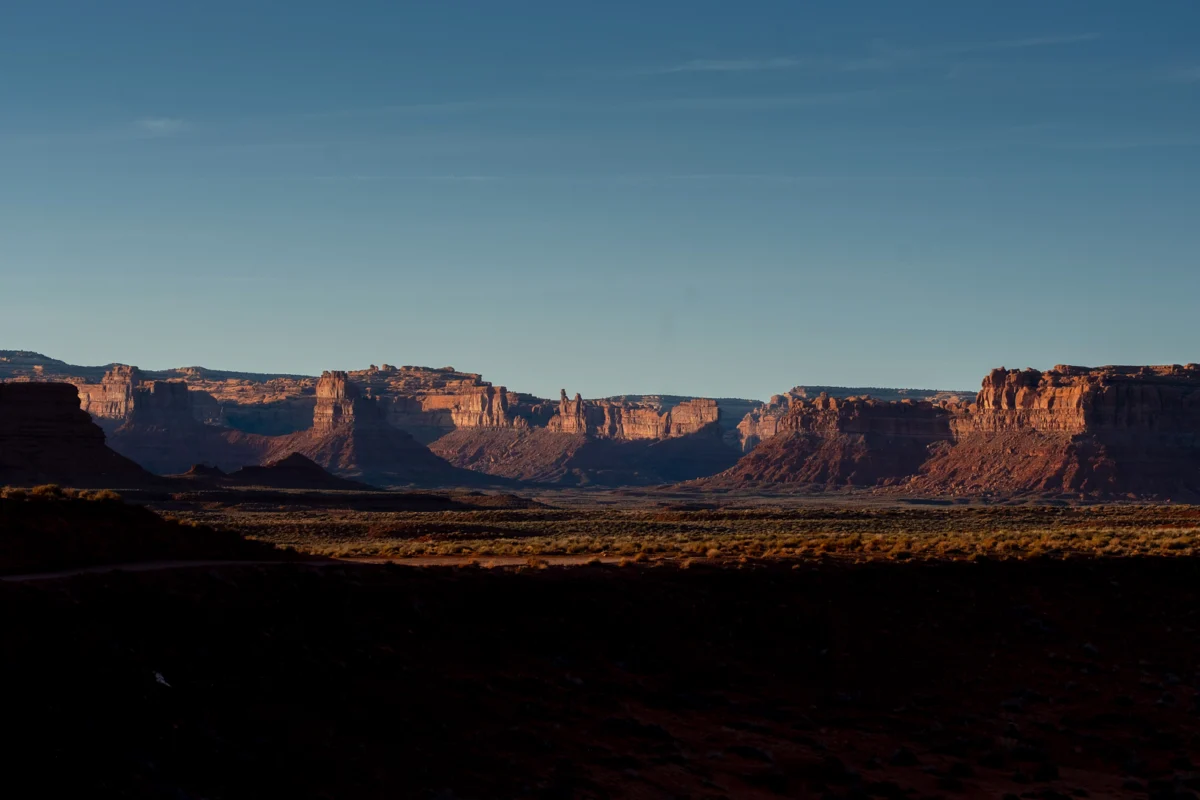
Radiating outward from both the Et Al and Owens sites are enigmatic linear swales, human-built features extending for more than a mile in remarkably straight lines. While their precise function remains a subject of ongoing archaeological inquiry, these "roads" are widely believed to be ceremonial or symbolic constructions. They likely served not only to link communities physically but also to forge spiritual connections to sacred mountains, prominent landforms, and other significant points within the vast cultural landscape. The enduring power of these connections spans generations; evidence such as Hopi pottery from the 15th century—centuries after the original inhabitants departed Cedar Mesa—has been discovered along the Et Al "roads," indicating that the descendants of these ancient peoples continued to honor and revisit their ancestral homelands, maintaining a deep, unbroken cultural thread across time. These ancient "roads" emphatically demonstrate that these structures cannot be understood in isolation; they are inextricable components of a meticulously crafted cultural and natural landscape, where every feature held meaning and purpose.
The intricate tapestry of Cedar Mesa’s cultural and natural heritage gained critical protection in 2016 when President Barack Obama, responding to a historic request from a coalition of five sovereign tribal nations with ancestral ties to the region, established the expansive Bears Ears National Monument (BENM). This landmark designation safeguarded not only thousands of irreplaceable archaeological sites like those described but also the surrounding lands, recognizing the holistic interconnectedness of the landscape. However, the monument’s future became a flashpoint in the ongoing debate over public lands management in the American West. In 2017, President Donald Trump controversially moved to significantly shrink the boundaries of both Bears Ears and the nearby Grand Staircase-Escalante National Monument (GSENM). While President Joe Biden later restored both monuments to their original sizes, the legal and political debate over these protections continued, recalling the extensive reductions enacted by the Trump administration in 2017 that significantly curtailed Bears Ears and Grand Staircase-Escalante by approximately 90% each, removing protections from millions of acres of public lands, including nearly all of Cedar Mesa and its invaluable Ancestral Puebloan sites like Et Al and Owens. These reductions, though reversed by Biden, set a precedent and highlighted the vulnerability of such designations to shifting political tides.

The 2017 boundary cuts were unprecedented in their scale. At Grand Staircase-Escalante, the Trump administration removed 1.69 million acres from national monument status. This action immediately revived the prospect of coal mining on previously leased areas within the fossil-rich Kaiparowits Plateau, a globally significant paleontological treasure trove, as well as uranium extraction in the historic Circle Cliffs mining district and extensive oil and gas drilling throughout the once-protected area. Concurrently, restrictions on motorized travel, vegetation clearing, and livestock grazing were eased across the diminished remnants of both monuments, opening these sensitive ecosystems to increased impact.
Crucially, the Trump administration’s actions also terminated the Bears Ears Commission, a pioneering co-management body comprising representatives from the five tribal nations—the Hopi Tribe, Navajo Nation, Ute Mountain Ute Tribe, Ute Indian Tribe of the Uintah and Ouray Reservation, and Zuni Tribe—who had been instrumental in advocating for the monument’s creation and developing its initial management plan. This unprecedented collaborative model for federal land management was dissolved, signaling a clear hostility towards tribal sovereignty and self-determination in the stewardship of ancestral lands. Further underscoring this stance, federal agencies controversially removed the five tribes’ seals from official signs at what remained of Bears Ears, a symbolic but deeply offensive act that erased visible recognition of indigenous peoples’ integral connection to the land.
The proclamations justifying these monument reductions purportedly cited the authority of the 1906 Antiquities Act. This landmark legislation, signed into law by President Theodore Roosevelt, empowers presidents to set aside federal land to protect natural landmarks, archaeological sites, and "other objects of historic or scientific interest." However, legal scholars and conservation advocates widely contend that the Act grants presidents the power to establish national monuments but not to unilaterally rescind or substantially reduce them, arguing that such authority is exclusively reserved for Congress. This fundamental legal question is expected to reach the Supreme Court, as a cascade of lawsuits filed by tribal nations, environmental organizations, and conservation groups makes its way through the judicial system, seeking to reaffirm the integrity of these protected landscapes.

Beyond the legal challenges, the administration’s proclamations also argued that expansive national monument status was unnecessary because the lands in question were already protected by other existing federal laws and regulations. This assertion, however, stood in stark contrast to the administration’s broader agenda of "energy dominance," which actively sought to diminish and dismantle those very same environmental and cultural protection regulations. One particularly concerning move targeted Section 106 of the National Historic Preservation Act, a crucial safeguard that theoretically protects cultural sites from destructive development and mandates consultation with tribes whose ancestral sites may be impacted. The attempt to incapacitate this key provision underscored a strategic effort to clear the path for resource extraction.
The White House’s legal justification for the monument cuts revealed a fundamental misunderstanding of the area’s landscape and its profound historical significance. The administration claimed that the original boundaries encompassed an excessively large area, thereby failing to comply with the Antiquities Act’s requirement that designations be confined to the "smallest area compatible with the proper care and management of the objects to be protected." This reductionist interpretation was echoed in a lawsuit filed by the state of Utah, which acknowledged the presence of a handful of "objects" worthy of protection but argued they were distinct from the surrounding landscapes and should therefore be protected on a strictly individual basis.
Trump’s redrawn boundaries rigorously adhered to this reductionist philosophy, carving out isolated pockets around the most visually striking or well-known landmarks and historic sites, while dismissing vast tracts of the surrounding ecosystem as merely "generic topographic and geologic features." In Grand Staircase-Escalante, for instance, the administration eliminated virtually all of the monument’s west side, leaving only a tiny square and a similarly sized strip near the community of Big Water. This latter area was preserved because it was the site where paleontologists discovered the bones of Sarabosaurus dahli, a new taxon of the ancient Turonian mosasaurid, a sea-going dinosaur. Yet, this narrow focus ignored the undeniable reality that this ancient creature and its contemporaries did not confine themselves to such a minuscule area; indeed, crucial fossils abound across hundreds of thousands of acres of the Kaiparowits Plateau. This vast, fossil-rich landscape, also abundant in coal, oil, and gas, consequently lost its protections, highlighting a clear prioritization of resource exploitation over comprehensive conservation.

Bears Ears, similarly, was drastically reduced to two primary units, Shásh Jáá and Indian Creek, along with a handful of tiny, discrete units extending monument status to a few isolated Ancestral Puebloan sites like Doll House, Moon House, and the Citadel. Ironically, the proclamation also protected the Scorup Cabin, once inhabited by the "Mormon Cowboy" A.J. Scorup, and even an oil well drilled in 1926—a perplexing decision to protect an ancient oil well from potential oil and gas development, while opening vast swaths of the cultural landscape to new drilling.
This narrow, object-centric approach stands in stark contrast to the original intent and historical application of the Antiquities Act. Had President Theodore Roosevelt, its architect, followed similar logic when he first established Grand Canyon National Monument in 1908, he would not have protected the sprawling 800,000 acres of the canyon. Instead, he would have designated a collection of much smaller, isolated "units," each containing a singular landmark—Havasu Falls, for example, or Mather Point, Vishnu Temple, or Bright Angel Point. Roosevelt, however, possessed a far deeper understanding of the American West and its interconnected ecosystems than the proponents of the monument reductions. He recognized that sacred and scientifically significant landscapes are profoundly more than the mere sum of a handful of discrete "objects." Can one truly separate the awe-inspiring Vishnu Temple from the colossal grandeur of the Grand Canyon? Such so-called discrete "objects"—whether geological formations, ancient dwellings, or other cultural sites—cannot be meaningfully separated from the encompassing landscape itself, because doing so strips them of their essential context, meaning, and scientific value. Therefore, to genuinely protect these "objects," as the Antiquities Act explicitly authorizes the president to do, one must also protect the integral landscapes that define, sustain, and connect them.
The Supreme Court has, in fact, previously affirmed this holistic concept. After Roosevelt invoked the newly enacted Antiquities Act to establish the Grand Canyon National Monument, a mining claimant within the canyon sued, challenging the designation. The justices, however, ruled decisively against the mining interests, asserting in their opinion that the law empowered the president to "establish reserves embracing ‘objects of historic or scientific interest.’ The entire Grand Canyon, as stated in his proclamation, is ‘an object of unusual scientific interest.’" This ruling provided a clear judicial precedent for understanding entire landscapes as unified "objects" worthy of protection.

President Obama brought this holistic concept to fruition on an even grander scale when he established Bears Ears, aiming to protect not only prominent individual sites like Et Al but also the ceremonial "roads," shrines, ancient agricultural fields, and natural landforms that constitute their interconnected environment. The "objects of historic and scientific interest" in these cases are undeniably more than discrete landmarks, as the very land itself—and particularly the Ancestral Puebloan sites, with their profound synthesis of natural form and human community—makes abundantly clear. As Santa Clara Pueblo artist, architect, and scholar Rina Swentzell eloquently articulated in a 1991 paper on Ancestral Puebloan architecture, "Here, the human landscape is meaningless outside the natural context — human constructions are not considered out of their relationship to the hills, valleys and mountains." Swentzell further emphasized that the material village "constitutes one place within the whole. The web of human existence is interlaced with what happens in the larger natural context and therefore flows into the adjacent spaces, hills, and mountains." This indigenous perspective offers a crucial counterpoint to the reductionist view, underscoring that the true value and significance of these irreplaceable landscapes lie in their entirety and the intricate relationships that bind every element, both natural and cultural, into a sacred whole. The ongoing legal and political battle for Bears Ears and Grand Staircase-Escalante thus represents more than a dispute over land; it is a fundamental clash of philosophies regarding how humanity perceives, values, and stewards the planet’s most precious natural and cultural heritage.