Roger Danuarta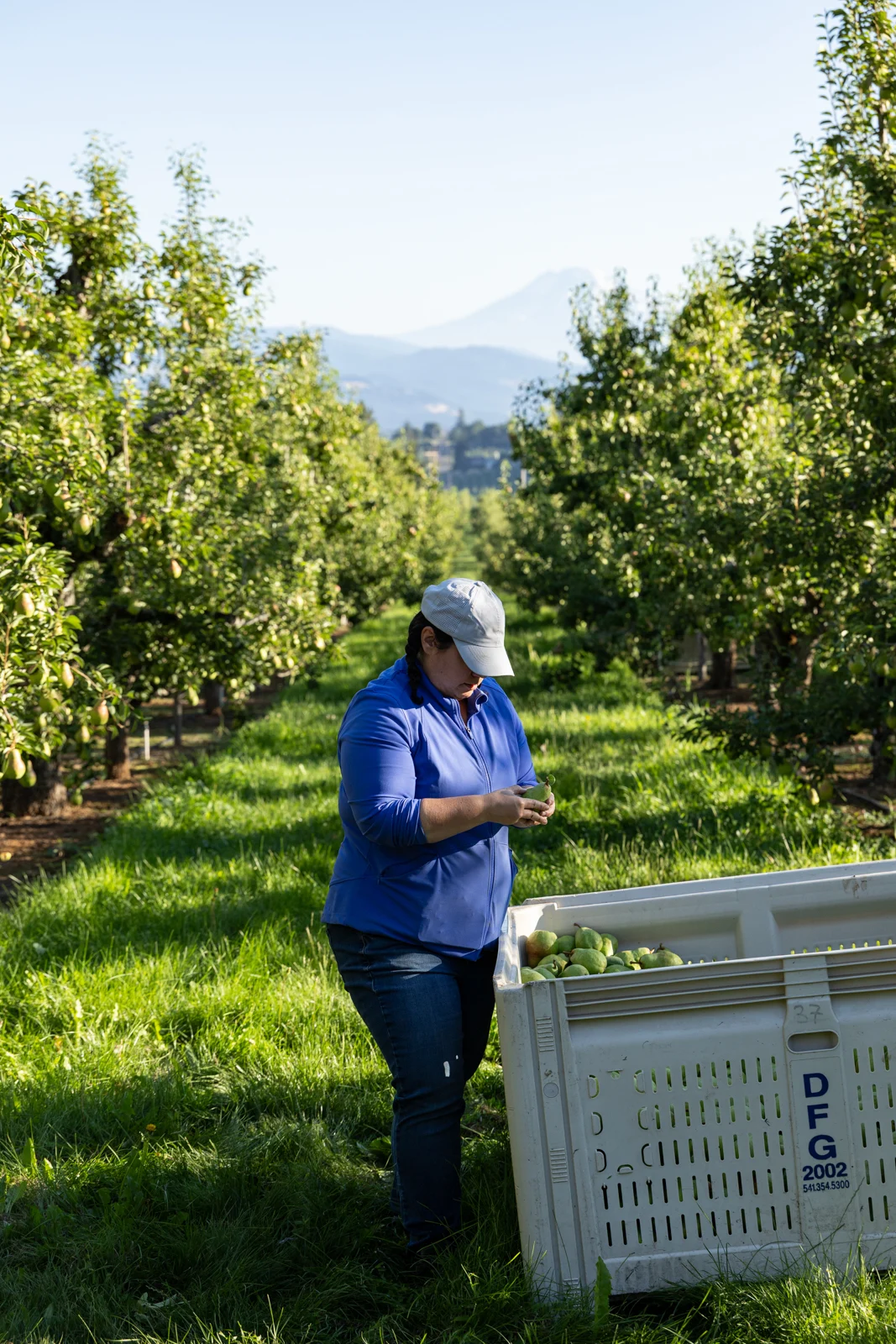
The serene beauty of Hood River, Oregon, with its iconic Mount Hood backdrop, belies a deepening crisis for the region’s venerable pear growers. On a clear August morning, Lesley Tamura, a fourth-generation pear farmer, surveyed her 42-acre orchard, the rhythmic sounds of Spanish radio accompanying workers harvesting green Bartletts. For Tamura, whose family has cultivated this land for over a century, the present challenges echo, in a new and complex way, past trials her ancestors endured. Her great-grandfather established this farm, a legacy that miraculously survived even the egregious period of Japanese American incarceration during World War II, a time when countless other families lost their ancestral lands and livelihoods. This enduring heritage once seemed an unbreakable bond with the land, a testament to resilience. Now, eight decades later, Tamura questions if that storied luck has finally run its course.
"As much as we do this because we love it, it’s just getting harder and harder each year," Tamura stated, her voice tinged with the gravity of her family’s predicament. "I would love to survive doing this and doing it well, but I’m not sure that’s possible." This sentiment resonates across the Hood River Valley, a region that, alongside neighboring Washington, accounts for nearly 90% of the fresh pears consumed in the United States, making it a critical hub in the nation’s fruit supply chain. The stakes are immense, not just for individual families but for the broader agricultural landscape and consumer access to this staple fruit.

Last year, the Hood River pear growers collectively faced staggering losses estimated between $40 million and $45 million. This financial hemorrhage stems from a confluence of factors: persistently low revenue, soaring production costs, and the devastating impact of an unprecedented pest outbreak. In response to this escalating crisis, Oregon Governor Tina Kotek formally petitioned the U.S. Department of Agriculture (USDA) for a disaster designation. Such a declaration would unlock crucial federal relief, including access to low-cost loans and other financial aid programs designed to support agricultural communities in distress. However, experts warn that even with federal intervention, the future remains precarious. Tim Delbridge, an agricultural economist with the Oregon State University Extension Service, painted a stark picture: "I think it’s safe to say that many pear producers will be either reducing pear acreage or, frankly, going bankrupt." The potential loss of these farms could have profound implications for regional employment, local economies, and the national pear market.
Each spring, the Hood River Valley transforms into a breathtaking expanse of delicate white pear blossoms. The region’s unique microclimate, characterized by warm days and cool nights, fertile volcanic soil, and abundant water from glacial runoff, has historically provided ideal conditions for pear cultivation. Yet, in 2025, the valley’s trees were plagued by an additional, unwelcome bloom: the pear psylla. This minute insect, a close relative of the aphid, feeds voraciously on pear trees, excreting a sticky, sugary substance known as honeydew. If left on the fruit, this honeydew creates a breeding ground for sooty mold, rendering the pears unmarketable despite being edible. The sheer scale of the psylla population last year was extraordinary, far exceeding typical outbreaks. While scientists are still working to definitively identify the underlying causes, a growing consensus points to climate change as a significant contributing factor. Warmer winters and earlier springs can disrupt natural predator cycles and accelerate pest reproduction, leading to unprecedented population surges. Horticulturalist Ashley Thompson, who studies the region’s pear crops, articulated the scientific community’s frustration: "It’s really hard for us to tease apart all of these big ecological interactions and try and figure out exactly what’s happening. We don’t have good answers, and that’s frustrating for us and for the farmers." This uncertainty compounds the challenge for growers, who are left grappling with novel threats without clear, proven mitigation strategies.
In a desperate attempt to salvage their harvest, Hood River pear farmers undertook intensive measures, regularly hosing down their trees to wash away the sticky honeydew. Tamura, for instance, reported using roughly triple her normal seasonal water allocation, a significant expenditure of both resources and effort, especially in a region increasingly conscious of water scarcity due to persistent drought conditions across the Western United States. These heroic efforts initially appeared successful, as growers managed to cleanse most of their fruit. The harvest itself was remarkably abundant, leading to a massive surplus. Ironically, this very success contributed to a sharp decline in market prices, a classic supply-and-demand dilemma for producers. Adding to the market glut was the untimely closure of a prominent cannery in Yakima, Washington, a long-standing processing facility that traditionally absorbed a substantial portion of the region’s excess fruit, diverting it from the fresh market and stabilizing prices. Its closure eliminated a critical outlet, further exacerbating the oversupply.

Believing they had averted catastrophe, farmers, in August and September, meticulously packed and shipped a year’s worth of their labor to nearby packing companies. These facilities would then store the fruit in controlled environments, gradually releasing it to the market over the ensuing months. However, the true extent of the disaster only became apparent in January, when packers began opening stored boxes of pears. They discovered that despite the growers’ diligent efforts, not all the honeydew had been removed, and countless bins of fruit had developed unsightly mold, rendering them unsellable and fit only for discard. This revelation sent shockwaves through the farming community. For Tamura, who also chairs the Columbia Gorge Fruit Growers, the financial implications were devastating. For each bin of pears she had cultivated, at an average cost of approximately $300, the packinghouse would pay her anywhere from nothing to, at best, $150. In some harrowing instances, growers were even billed by the packers to cover the costs associated with discarding the spoiled fruit. "We paid to grow the pears, we paid to pick the pears, we paid to pack and store the pears," Tamura lamented, describing the bitter reality. "We’re going to pay for the cost to discard them as well." The emotional toll was equally profound, with Tamura recalling the grim sight of sticky pear juice staining the roads near the packing facility as truckload after truckload of moldy fruit was hauled away, symbolizing shattered hopes and wasted effort.
The traditional safety net of federal crop insurance, designed to shield farmers from such unforeseen calamities, proved inadequate in this unique situation. Crop insurance policies typically mandate that farmers notify their insurers shortly after harvest to qualify for coverage. However, the full scope of this particular disaster, the hidden mold within the stored fruit, only manifested months later, long past the notification window. This critical gap in coverage left growers exposed, prompting Tamura and her colleagues to appeal directly to Governor Kotek for urgent assistance. The governor’s July letter to the USDA outlined a comprehensive request for various relief measures, including emergency loans, direct relief payments, and other programs to help growers navigate the unprecedented financial hardship. A USDA spokesperson confirmed receipt of the letter, stating, "USDA has received Gov. Kotek’s letter and is actively working to gather the necessary data and information," signaling the federal government’s engagement with the crisis.
The economic structure of the agricultural industry places pear producers at a distinct disadvantage. As they often articulate, "We’re price takers, not price makers." This fundamental imbalance means that large retailers and distributors dictate the prices paid for produce, leaving farmers with little leverage and no choice but to accept the offered terms if they wish to move their perishable products. Compounding this challenge, farmers often operate in a state of prolonged financial uncertainty, as they do not receive their full payment for a harvest until nearly a year after the fruit has been picked. While partial distribution checks may arrive starting in January, the final, complete payment only materializes once the packinghouses and retailers have deducted their substantial shares. "We just get whatever’s left over," Tamura explained, highlighting the inherent inequity. "And for a very long time now, that amount is not even enough to cover our costs."

This financial squeeze is starkly illustrated by pricing data. According to the USDA, Oregon’s pear farmers received an anemic average of $473 per ton for their pears in 2008. Seventeen years later, in 2025, that figure remained precisely the same: $473 per ton. Over the same period, the cumulative impact of inflation has seen the cost of living and doing business surge by an estimated 54%. While various factors contribute to this stagnation, many agricultural advocates and economists point to the increasing consolidation within the retail grocery sector. Just four major companies now command an estimated two-thirds of America’s grocery dollars, granting them immense bargaining power over producers. While some research on the direct causal link between retail consolidation and lower farmgate prices remains inconclusive, as noted by economist Delbridge, the intuitive connection suggests a significant impact on farmers’ profitability. This concentration of power in the hands of a few large buyers is a global trend, affecting farmers across various commodities and regions, making it harder for small and medium-sized producers to negotiate fair prices.
Beyond structural economic issues, pear growers also contend with shifting consumer preferences. Since the 1980s, the consumption of canned pears in the United States has plummeted by approximately 70%, reflecting a broader consumer move away from processed foods. Demand for fresh pears, while more stable, has remained sluggish, especially when compared to the dramatic surge in popularity of other fruits, such as fresh berries, whose consumption has more than tripled. Delbridge suggests that a key challenge for pears lies in consumer education. Many shoppers expect pears to be ready to eat immediately upon purchase, unaware that most varieties require several days of ripening on the counter to achieve optimal flavor and texture. Tamura concurred, observing, "People are so used to the immediate results of ordering things and getting same-day delivery. We’ve lost a bit of our patience, and that works against us as pear growers." In an era of instant gratification, the humble pear demands patience, a virtue increasingly scarce in modern consumer habits.
As revenue has stagnated for nearly two decades, pear producers’ operational expenses have spiraled upward. Since 2008, not only have labor costs risen significantly, but the overall cost of essential agricultural inputs—from fertilizers and pesticides to fuel and equipment—has climbed dramatically due to inflationary pressures. Mike McCarthy, a pear grower in Parkdale, just a short distance from Tamura, has witnessed these changes firsthand over his 47-year career. He estimates that labor now constitutes a staggering 60% of his total expenses. McCarthy highlighted the unintended consequences of well-intentioned regulations, such as Oregon’s recent laws mandating farmworker overtime pay and improved housing standards. While these regulations aim to enhance worker welfare, they have simultaneously placed immense financial strain on farmers, pushing many beyond their operational capacity.

Last season, McCarthy unequivocally declared, was the worst of his extensive career. To survive and continue farming for another year, many of his fellow growers have resorted to desperate measures, "borrowing to the hilt," even taking out new mortgages on land that had long been paid off. Others, unable to sustain the mounting pressures, have sold their generational farms to larger corporate operations or simply abandoned their orchards altogether. "There’s a number of abandoned orchards around the county now, which is very unusual," McCarthy noted with sadness. "It seems like the number is growing all the time." The sight of neglected, unkempt orchards, once vibrant symbols of prosperity, now stands as a stark visual testament to the profound agricultural crisis gripping the region. While McCarthy nears the end of his own career, his deepest concern lies with the younger generation of farmers who inherit this increasingly challenging landscape. "That’s really where the rubber meets the road is with these younger people," he emphasized. "Many of them are just super depressed." The future of these family farms, integral to the cultural fabric and economic vitality of communities like Hood River, hangs precariously in the balance.
Despite the formidable obstacles and the profound emotional toll, Lesley Tamura clings to a fragile hope. Early indications for the current harvest suggest a smaller crop, which, paradoxically, could lead to better prices due to reduced supply. Crucially, the presence of the pear psylla appears significantly diminished compared to last year’s devastating outbreak. These two factors offer a glimmer of optimism that the upcoming season might provide some much-needed respite. Tamura is "keeping her fingers crossed for a good season," one in which, she hopes, her family farm can at least break even, a modest but vital goal in the face of such overwhelming adversity. The fate of Oregon’s pear industry, deeply intertwined with its history, environment, and the livelihoods of countless families, now hinges on this delicate balance of natural cycles, market forces, and the enduring spirit of its resilient growers.