Roger Danuarta
In November 2024, the U.S. Forest Service issued a forceful cease-and-desist letter to Galena Mines LLC, a Boise-based company that owns historic mining claims in the Sawtooths, following the discovery of an unpermitted cabin constructed that fall. At the time, Michael Boren was listed as the sole manager of Galena Mines LLC, a company he formed in 2020. The USFS determined that the cabin, a seemingly unfinished log structure, was built approximately one mile north of Galena Mines’ patented claims, on federal public land within the protected Sawtooth National Recreation Area. The agency unequivocally ordered Galena Mines and Boren to remove the cabin by July 1, 2025, and submit a comprehensive restoration plan within 45 days, to be completed no later than August 1, 2025.
Kirk Flannigan, the area ranger for the Sawtooth National Recreation Area, underscored the gravity of the situation in his formal letter, stating, "Because there is no authorization for the surface disturbance and construction of the cabin that has occurred on [Forest Service] land, the cabin must be removed and the area restored to its natural condition." Flannigan’s communication further warned that "failure to comply with this notice may result in referral of this matter to the United States Attorney for the District of Idaho for appropriate legal action or removal and impoundment of the improvements at your expense," highlighting the serious legal ramifications for unauthorized occupation of federal lands.
Despite these clear directives and the looming deadlines, the cabin stands defiantly nearly two years later in late 2026, a symbol of stalled federal enforcement. This inaction is particularly troubling given Boren’s current position as the Undersecretary of Agriculture for Natural Resources and Environment, a role in which he directly oversees the U.S. Forest Service and its management of approximately 193 million acres of public land, including the very segment of the Sawtooths where the cabin is located. This unprecedented overlap of personal interest and public duty raises significant questions about accountability and the integrity of federal land management.
The ongoing presence of the cabin came to light recently when Aaron Murphy, co-founder of the advocacy group American Hunters and Anglers, traveled to central Idaho and located the structure. His organization subsequently posted video footage of the cabin, situated in a clearing along a Forest Service road in the rugged Boulder Mountains, on its social media platforms, igniting public outrage. In an interview, Murphy condemned the Forest Service’s failure to enforce its own orders, emphasizing the principle that no individual, regardless of their position, should be above the law when it comes to the preservation of public lands.
At the heart of the dispute lies a complex and contentious debate over the precise boundaries of Galena Mines’ patented mining claims. Patented claims, unlike unpatented ones, grant full ownership of both surface and mineral rights to the claimant, effectively privatizing a parcel of public land. The exact location of these claims is therefore critical in determining whether the cabin was built on private property or federal public land.
Government watchdog group Campaign for Accountability, through a public records request, obtained and shared internal communications and records that reveal a history of conflicting surveys. In 2003, a previous owner of the claims commissioned a survey by Kim Leavitt, who concluded that the claims were situated along Germania Creek, approximately one mile north of the locations depicted on official Bureau of Land Management (BLM) maps. However, in 2004, USFS and BLM staff conducted their own survey, with Forest Service land surveyor Randall Peppersack concluding that Leavitt’s findings were incorrect. Peppersack’s report explicitly stated, "In fact, Mr. Leavitts [sic] location is approximately 1 mile north of the original location and approximately 2000 feet lower in elevation. The location of the Dezdon Lode and Millsite are incorrectly displayed on the Leavitt Record of Survey." The BLM’s mineral and land records database continues to show the claims in a less accessible spot, a mile south of the cabin’s current location.
The plot thickened in November 2020, just a week before Galena Mines LLC was formally established, when Mark Phillips, a surveyor hired by Boren from Galena Engineering Inc., filed another survey with Custer County. Mirroring Leavitt’s earlier findings, Phillips’ survey asserted that the patented claim lay a mile north of the federal agencies’ documented location. A USDA spokesperson later confirmed that Boren had commissioned Phillips to "place survey markings on site to ascertain exact boundaries."
Emails from November 2024 between Ranger Flannigan and Forest Service law enforcement officer Fallon Higgins detailed a meeting where Boren and Flannigan discussed the cabin and the cease-and-desist order. Flannigan noted that Boren "did not acknowledge any wrong doing, but basically said if he did build in the wrong place he would move the structure. He also asked about the rehabilitation plan that is mentioned in the letter." Boren reportedly informed Flannigan that the location chosen for construction had been "verified by a local engineering firm before Mike purchased the claim," suggesting potential financial responsibility for the firm if the location proved incorrect. Flannigan also recounted Boren reiterating "several times that ‘he did not want to fight’."
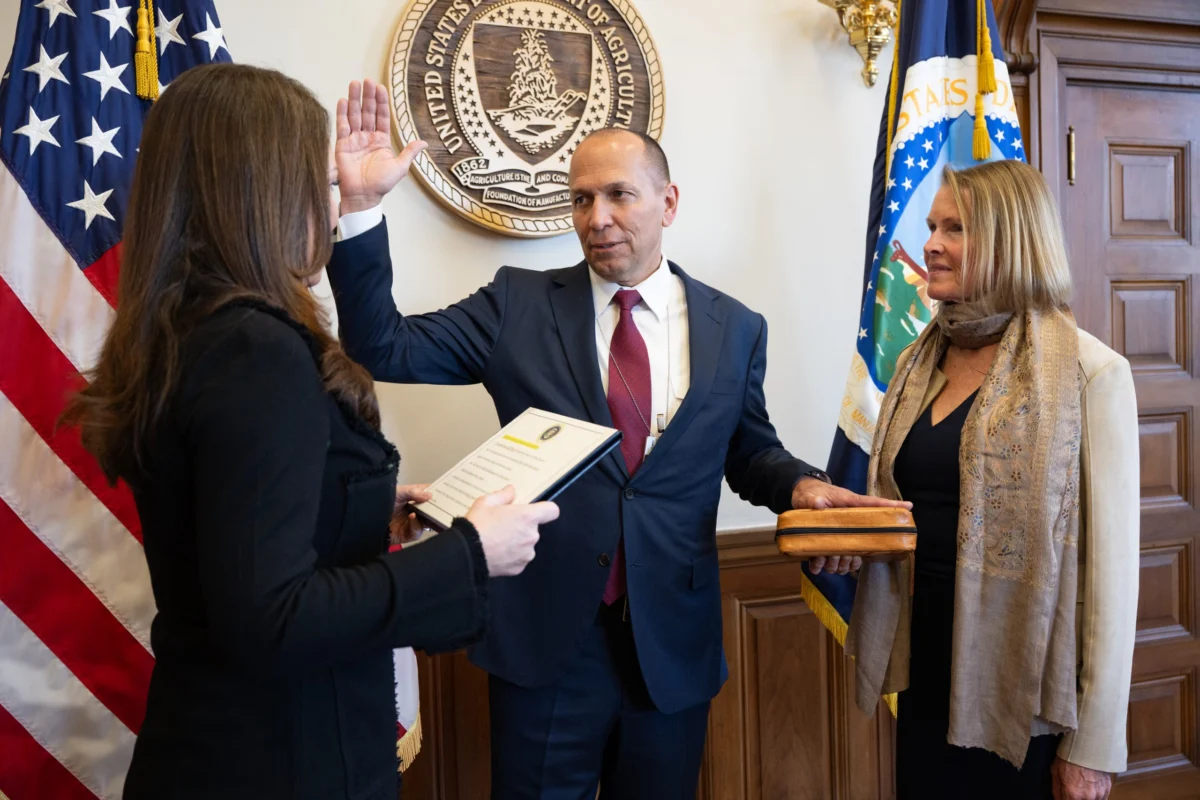
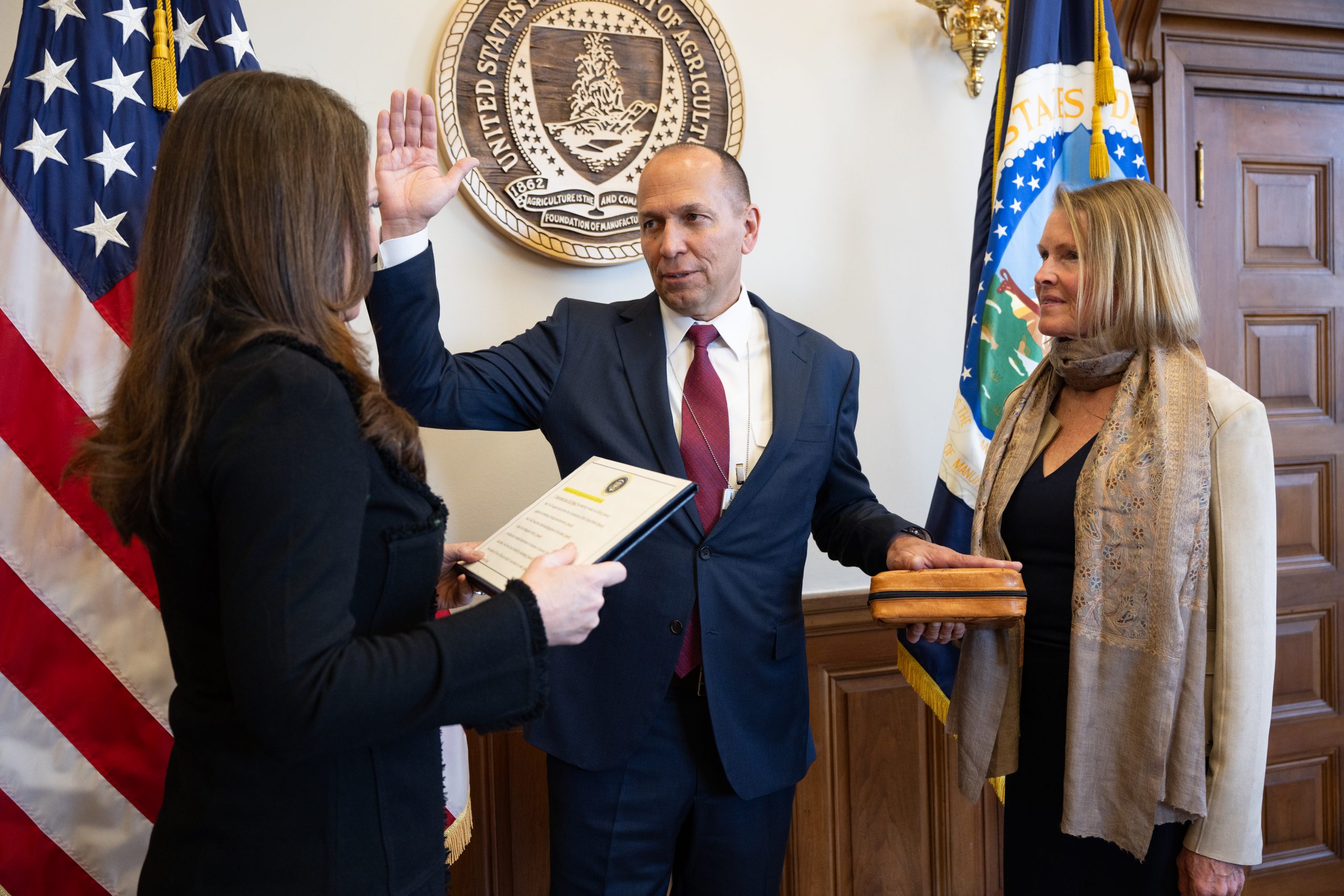
On January 8, 2025, days before then-President-elect Trump’s return to office, Higgins requested the cease-and-desist letter, indicating he was "finalizing the case report on my end for now, just so everything is documented in case we need to move forward with any charges in relation to this at a later date." Just over a week later, on January 17, 2025, Trump nominated Boren for the USDA undersecretary post. Boren, who has a documented history of clashes with public land management agencies, including the Forest Service, was subsequently sworn into his powerful new position in January 2026.
Since Boren’s appointment to the USDA, the Forest Service’s stance on the cabin has undergone a dramatic reversal. The agency, now under Boren’s purview, shows no signs of enforcing the demands it made of Boren and Galena Mines in 2024. The USDA has largely dismissed the Forest Service’s prior assessment of the claim boundaries, instead deferring to the two independent surveys (Leavitt’s and Phillips’) that placed the claim where the cabin was built. A USDA spokesperson characterized these private surveys as "official" records, stating, "The USFS does not conduct official land surveys of patented mining claims; it contracts the Bureau of Land Management surveyors with appropriate expertise." The spokesperson added, "To our knowledge, BLM has not conducted a survey of the relevant parcel. Mr. Peppersack’s comments do not constitute an official survey and were not recorded as such," effectively invalidating the Forest Service’s previous federal assessment.
When pressed on whether the Forest Service intended to require Galena Mines to remove the cabin and restore the area, the USDA spokesperson unequivocally stated, "No action can be taken until an official federal survey is completed." This stance directly contradicts the 2024 cease-and-desist letter, which explicitly referenced "official government records and surveys" placing the patent in a section of land south of the disputed cabin location. Furthermore, in a November 2024 update to his 2004 survey report, Forest Service land surveyor Peppersack reiterated his concerns, noting that "the current landowner and the 2020 Phillips survey are relying on Leavitt’s survey, even after the Forest Service land surveyors notified Mr. Leavitt in 2004 that it was incorrect." Peppersack’s report concluded with a clear recommendation: "Recommend trespass notification if any improvements or other unauthorized use is commenced on these Leavitt locations."
Regarding the cabin’s purpose, the USDA spokesperson claimed it was built by "backcountry skiers… on private land for public use as needed. It has no other purpose." When confronted with video footage from American Hunters and Anglers showing the cabin’s door boarded over, the spokesperson suggested, "The hut could be used in the event of a winter emergency." The USDA also dismissed American Hunters and Anglers’ social media video as "maliciously false and therefore libelous," an unusual and aggressive response from a federal agency.
Compounding the controversy are serious ethics questions surrounding Boren’s financial disclosures. In April 2025, a few months after his nomination, Boren signed an ethics agreement and submitted a financial disclosure, neither of which listed Galena Mines LLC. Craig Holman, a government affairs lobbyist and ethics expert at the progressive watchdog group Public Citizen, stated that ethics rules mandate Boren disclose all outside corporate posts held during the preceding two years. The USDA spokesperson maintained that Boren’s financial disclosure was "accurate" because "neither he nor his family had ownership of Galena Mines at the time of the initial financial disclosure or any subsequent time," claiming the Boren family had not held an ownership stake in the LLC since May 2024. However, this assertion is directly contradicted by internal Forest Service emails indicating that agency officials discussed the cabin issue directly with Boren in November 2024, well after the alleged May 2024 ownership transfer. Furthermore, Idaho business records show Boren remained the LLC’s manager until late February 2025, a month after his nomination to the USDA undersecretary role, at which point his daughter, Amanda Boren, assumed the management position.
The Forest Service’s abrupt shift in policy regarding the Boren cabin has coincided with significant leadership changes within the Sawtooth National Forest. Kirk Flannigan, the ranger who issued the cease-and-desist letter, departed his Forest Service post in June 2025 to become administrator of Blaine County, Idaho. Similarly, former Sawtooth National Forest supervisor Jake Strohmeyer, a 30-year agency veteran, left his position in early 2025 for a role at the Idaho Department of Lands. Adding another layer of potential influence, Amanda Boren, daughter of Michael Boren and a board director of the private property rights group Sawtooth Conservation and Recreation Alliance (of which her father was a past board member), emailed top Forest Service brass in November 2025. In her letter to Forest Service Chief Tom Schultz, she endorsed Michael Fuller, then the acting area ranger of the Sawtooth National Recreation Area, for the permanent ranger post, while simultaneously criticizing Flannigan, stating, "Ranger Fuller seems to be able to get more done in 3 months with a staff of 9 people than the previous ranger was able to get done in 12 months with a staff of over 30." The profound irony is not lost: Amanda Boren’s father now directly oversees Michael Fuller, Tom Schultz, and every other employee within the U.S. Forest Service.
This complex saga in the Sawtooth National Forest highlights broader concerns about the integrity of public land management, the potential for political influence to override regulatory enforcement, and the paramount importance of transparency and accountability for high-ranking government officials. The unresolved status of the cabin, the conflicting survey interpretations, and the ethics questions surrounding Michael Boren’s financial disclosures underscore a critical moment for federal oversight and the public’s trust in the stewardship of national treasures. The ongoing inaction by the USFS raises fundamental questions about whether the rule of law can be applied uniformly, regardless of an individual’s power or connections, particularly when it comes to safeguarding America’s invaluable public lands.