Rocky Gerung
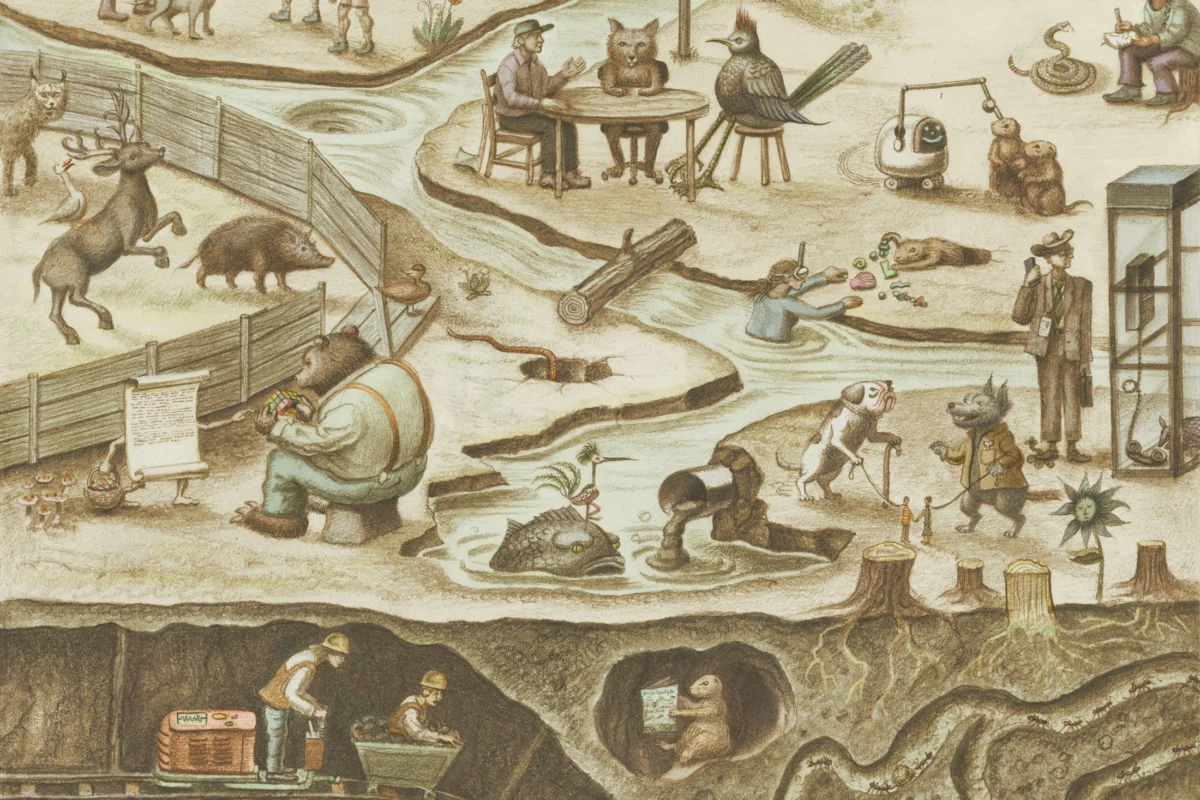
The challenge of visually representing the intricate tapestry of human communication proved to be a significant undertaking for the special August issue focused on Conversations, necessitating a cover image that could encapsulate its complexities. Fortunately, the former Visuals Editor, known affectionately as "Bear," had a clear vision, identifying artist Armando Veve as the ideal choice, a longtime and respected contributor to High Country News. For years, Bear and the editorial team had aspired to feature Veve’s distinctive artwork on the magazine’s cover, and the opportunity finally arose with the Conversations issue, which also marked Bear’s final contribution to the masthead.
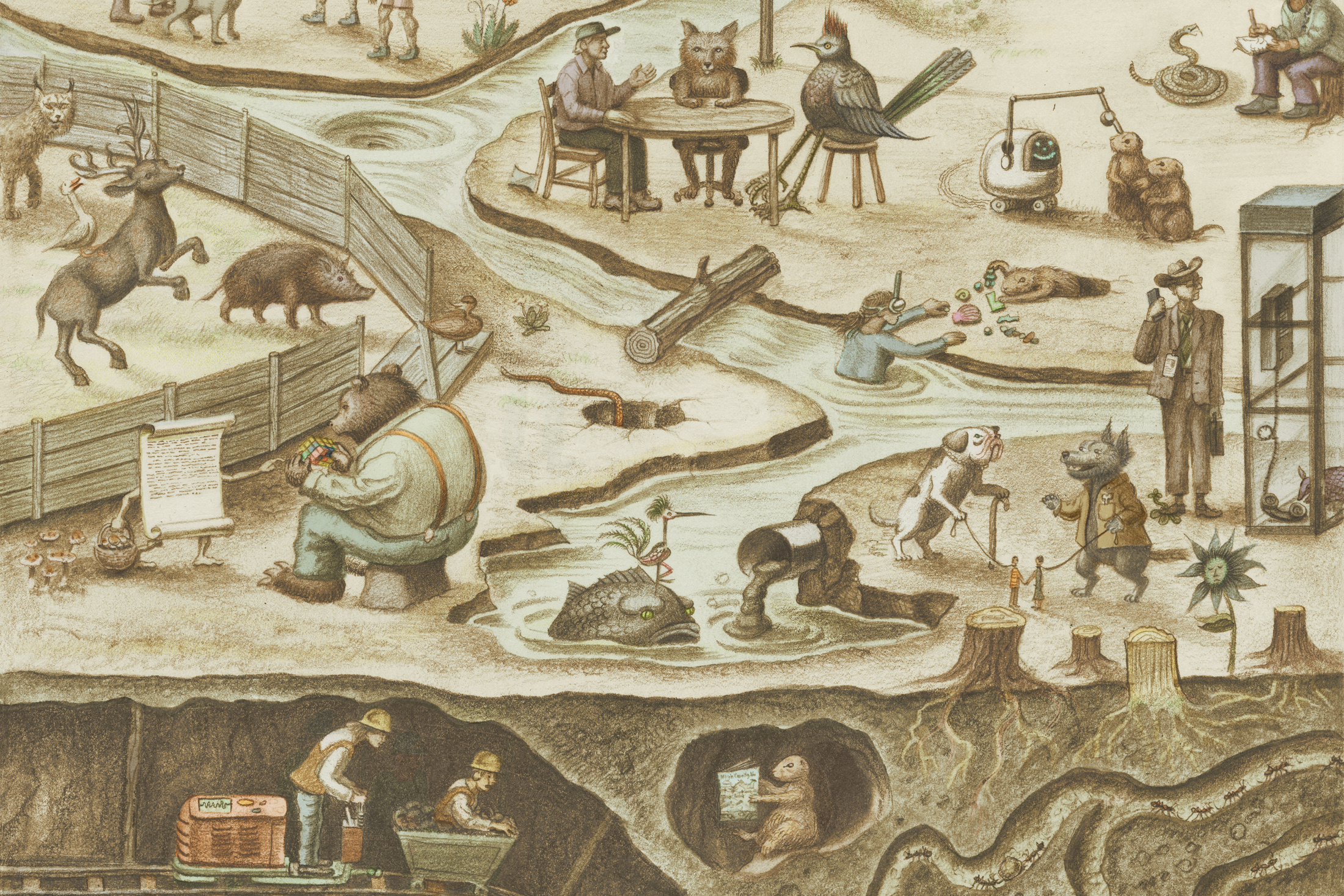
Veve embraced the assignment with his characteristic enthusiasm and unmistakable artistic style, crafting an illustration that masterfully depicts the winding nature of meaningful exchanges. He populated the scene with a whimsical array of unlikely conversationalists engaged in tense yet amicable interactions, thoughtfully leaving ample space for the vital element of convivial silence that often underpins deep connection.
Although Veve is based in Philadelphia, Pennsylvania, the HCN office in Paonia, Colorado, had the pleasure of meeting him a couple of years prior when he passed through during a road trip en route to a Telluride art gallery. This encounter offered a glimpse into his creative spirit, and it is hoped that readers will find a similar connection through his thoughtful reflections on his cover artwork and his broader artistic philosophy.
Veve’s artistic process is deeply rooted in graphite on paper, a medium he cherishes for its immediacy and its profound connection to the act of writing. He often conceptualizes drawing as a visual form of storytelling, akin to composing with words but expressed through images. His works are meticulously built up in sedimentary layers, beginning with graphite, followed by watercolor, and then colored pencil. For this particular piece, digital tools were employed to add color, a necessity dictated by time constraints, yet even these digital applications remain guided by the artist’s hand. The drawing and color coalesce on the printed page, which Veve views as the ultimate realization of his artwork within the context of publications like magazines and newspapers.
In his daily life, Veve finds inspiration by actively processing the world around him, using drawing as a means to center himself, navigate chaos, and give tangible form to his internal thoughts, sifting through them for meaningful insights. He is perpetually seeking inspiration, striving to heighten his awareness of his surroundings and to notice details that might otherwise escape casual observation. He consciously endeavors to reduce his reliance on digital devices, preferring to pay closer attention to the physical world and engage more deeply with other people. His practice includes embarking on long walks, sometimes with the intention of capturing photographic references, but often simply to create mental space and stimulate his circulation. More recently, Veve has found himself drawing more from memory and less from external reference materials, an approach he describes as invigorating and one that opens up new creative avenues on the page. Drawing serves as a conduit for maintaining a dialogue with both the past and the future, encouraging a more attentive gaze and fostering novel ways of thinking. Yet, it also fulfills a more primal urge, akin to scratching an itch—a process of peeling back surfaces, delving deeper in pursuit of symbolic meaning or compelling narratives.
For several years, Veve collaborated with the author on monthly illustrations for the "Heard Around the West" column. The spirit of that particular section is palpably present in the cover artwork, and astute readers may even recognize certain familiar characters. Veve explains that he loved contributing to the "Heard" section, recalling the peculiar and amusing stories curated by Tiffany (Midge), such as the man who propelled a peanut up a mountain with his nose, or the dog named Ghost, who famously left his home to live among coyotes. Indeed, a closer inspection of the cover reveals several "Heard" easter eggs, including Bo the Bear and Ghost, two characters who first made their appearance in that column. Veve finds immense satisfaction in remixing his earlier works and establishing connective threads between them, breathing new life into recurring motifs and characters. He also admits that his cat frequently appears in his pieces, encouraging viewers to keep an eye out for this recurring element. He perceives all his work as part of a single, evolving universe, where each new story provides fresh subject matter and thematic explorations, all orbiting a shared source of creative energy.
Veve likens his visual vocabulary—the objects, symbols, and motifs he employs to convey ideas—to characters in a play. They emerge when they best serve the conceptual framework of a piece, or sometimes simply out of a desire for personal amusement, a private inside joke. He particularly enjoys incorporating characters that seem out of place, having been removed from their original contexts. This theme of displacement, he explains, is a recurring exploration aimed at defamiliarizing the familiar, a practice stemming from a surrealist impulse. He views fragmentation and cross-pollination as more accurate metaphors for the world as he understands it.
The development of Veve’s distinctive style, characterized by its unique application of humor and whimsy, can be traced back to his childhood fascination with narrative-driven imagery, sparked by his first encounter with Disney’s Snow White and the Seven Dwarfs and the comic books that were a constant presence in his home. As a child, he was captivated by the I Spy books and the elaborate virtual mansions he constructed in The Sims, which often doubled as elaborate deathtraps for his digital families. These experiences instilled in him a sense of discovery and empowered him to build his own narratives. He sees a democratic quality in this, allowing the viewer to forge their own path through an image. This affinity for exploration extends to his appreciation for maps and cross-sections, as they vividly illustrate the interconnectedness of all things.
Veve enjoys revisiting his works, building them up in layers, and refining them through editing and refinement, much like a writer meticulously prunes a manuscript. He finds a peculiar stillness in the act of drawing, a stark contrast to the rapid pace of modern life. He considers the extensive time invested in a single subject, rendering marks with the direct, ancient stroke of a pencil, to be almost absurd. There is also something elemental about it, a literal engagement with the earth, as graphite and clay are encased in cedar. This practice connects him to a long tradition of art created by human hands, a tradition he feels is increasingly challenged by artificial intelligence and commercial pressures. His work draws lineage from the earliest cave paintings, illuminated manuscripts, WPA murals, and the imaginative worlds of pulp science fiction.
The term "style," Veve admits, is a complex one, placing undue emphasis on the surface of a piece. He prefers to think of it as solidified voice, akin to speech patterns, gait, or the unique way one perceives and processes information. Humor, he notes, is an integral component of his work; if an image provokes laughter, he tends to pursue that impulse. Whimsy, he believes, is a potent force that encourages free association and unsettles familiar structures. The humor in his art is often not a deliberate intention but rather emerges from the natural interactions within a piece or from an association the viewer makes, something that is evoked for them. The drawing, in essence, becomes a vessel for this emergent humor.
For the cover illustration, Veve found his inspiration while grappling with the visualization of conversation. He began contemplating maps as literal representations of interconnected webs and envisioned a "landscape of conversation." This phrase became the central driving concept for the entire piece. His research led him to medieval paintings and maps, whose stacked spatial arrangements and their capacity to invite viewers to wander and discover their own pathways through the artwork deeply resonated with him.
The most challenging aspect of visually depicting conversation, Veve found, lay in striking a delicate balance between inclusion and omission. He emphasizes the perpetual difficulty of building sufficient negative space and moments of rest between visual elements. Just as in a good conversation, he explains, there must be pauses for meaning to develop. His initial sketches, he recalls, were too crowded and overwhelmingly "loud." Consequently, he opted to reduce the scale of all elements and open up the composition, thereby creating literal pathways for the viewer and incorporating moments of quietude, such as the poignant image of a flower mourning the presence of stumps.
Among the myriad characters populating the cover, Veve’s favorite moment is the solitary prairie-chicken, whose expression of apparent confusion he finds particularly compelling.
For those wishing to explore more of Armando Veve’s artistic endeavors and stay updated on his new projects, he can be found on Instagram at @armandoveve or visited via his website at armandoveve.com.