Rocky Gerung
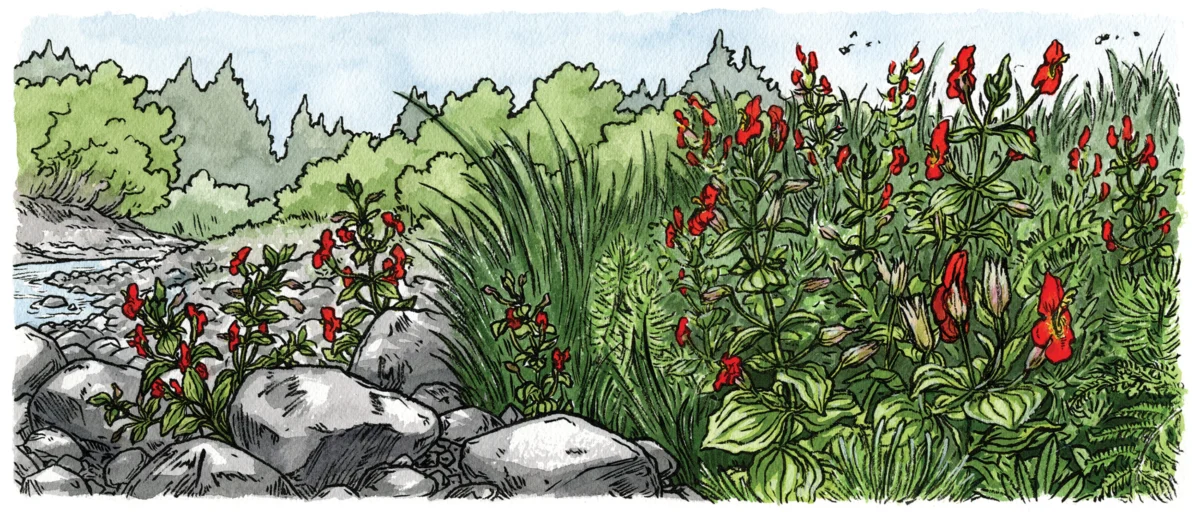
Throughout the warmer months, along the riparian corridors stretching from the Pacific Northwest down to Northern Mexico, a vibrant spectacle unfolds as hummingbirds flit between crimson, face-shaped blossoms that have undergone a remarkable co-evolutionary dance. These flowers, specifically the scarlet monkeyflower (Mimulus cardinalis), have developed intricate adaptations to perfectly match the feeding and pollination strategies of these tiny avian visitors. As autumn begins to cast its golden hue, these striking blooms transform into elongated, brown capsules, each containing thousands of microscopic seeds. It is at this stage that scientists, much like the hummingbirds before them, meticulously collect genetic material, transforming a natural reproductive strategy into a powerful tool for unraveling the complexities of evolutionary biology and forecasting how escalating climate change will reshape Western ecosystems.

A pivotal study, spearheaded by Amy Angert, an ecologist at the University of British Columbia, recently provided compelling evidence for the first time that certain plant species can evolve rapidly enough in natural settings to actively counteract the adverse effects of climate change. This research builds upon a growing body of discoveries centered on this small, trumpet-shaped flower. These investigations have illuminated how pollinators act as potent drivers of speciation, revealed the geographic variability in plants’ adaptive evolutionary potential, and demonstrated that a form of "intergenerational memory" within the floral lineage can facilitate adaptation to climatic shifts even in the absence of new genetic mutations. Angert’s lab is now leveraging these findings to develop sophisticated monkeyflower-based models, which hold the potential to predict the adaptive capacity of other species facing escalating threats such as drought, extreme heat, and wildfires. Her ultimate aim is to equip conservationists with the insights needed to prioritize conservation efforts, identifying those species and populations most in need of intervention, while recognizing others, like many of her studied monkeyflowers, that possess an inherent resilience, capable of "holding themselves up by their own bootstraps."
The journey from a streambank to a laboratory bench has been a cornerstone of Angert’s research since 2010, with her team visiting numerous monkeyflower habitats annually to record ecological data and gather seeds for controlled study. Through several groundbreaking investigations, her researchers have successfully "resurrected" multiple generations of seeds within the controlled environment of a greenhouse. These experiments have unequivocally shown that over successive generations, lineages subjected to drought conditions developed enhanced drought tolerance, manifesting in physiological changes such as modified leaf thickness and altered blooming periods. The scarlet monkeyflower possesses distinctive fuzzy leaves that secrete a sticky resin, emitting a unique aroma described by Angert as "a little sweet, a little pungent," a scent that instantly transports her back to the field. These perennial plants typically establish themselves in rocky niches along streambanks and creeks, thriving in areas where the water flow is dynamic enough to prevent encroachment by dominant meadow grasses but not so swift as to dislodge them. Scarlet monkeyflowers present a striking visual display, with their blooms arrayed on stems that can range from a modest six inches in arid, challenging environments to an impressive three feet in more mesic habitats.

The scarlet monkeyflower has emerged as a vital "model species" within the field of evolutionary biology, offering profound insights that extend far beyond its own ecological niche and hold relevance for a wide array of organisms. Its utility in scientific research stems from several key attributes: a long history of scientific study dating back to the early 19th century, a rapid life cycle, and a remarkable ability to thrive under laboratory conditions. Furthermore, the prolific seed production of the monkeyflower, with each capsule yielding over 2,000 seeds, facilitates efficient collection and propagation for research purposes. Historically, its relatively small genome size also contributed to its appeal, although this factor has become less critical with the declining costs of gene sequencing and the advancements in computational tools for genomic analysis.
The research conducted by Angert’s laboratory has revealed a significant disparity in adaptive potential between northern and southern populations of the scarlet monkeyflower, with southern populations exhibiting greater genetic variation for adaptation. This implies that they possess a superior capacity to evolve in response to environmental stressors compared to their northern counterparts. Consequently, researchers and conservation practitioners cannot rely on generalizations derived from a limited number of populations when assessing the adaptive capabilities of the species as a whole. Many plant species possess what is termed "stress memory," a phenomenon where epigenetic modifications, such as altered gene expression, are passed down through generations without involving changes to the underlying DNA sequence. This "memory" may also exhibit geographic variation within a species’ range. Angert’s team posits that even populations lacking the genetic capacity for rapid evolutionary adaptation might still leverage this epigenetic memory to adjust to a changing climate.

The scarlet monkeyflower’s evolutionary trajectory has been significantly shaped by its relationship with hummingbirds. Its bright red, tubular corolla, coupled with a rich nectar supply, serves as a powerful attractant. Crucially, the stamen’s structure is perfectly positioned to deposit two distinct pollen loads on the forehead of each visiting hummingbird, ensuring efficient pollen transfer. In contrast, a closely related species, Lewis’s monkeyflower (Mimulus lewisii), has specialized in attracting bumblebees. Its pink blossoms produce less nectar, and its broader petals provide a stable landing platform, facilitating pollen collection by these larger insects. While these two species share overlapping geographic ranges and are capable of hybridization, they rarely do so, a testament to the strong preferences of their respective pollinators. Evolutionary biologists have demonstrated that the divergence in floral morphology between these species is attributable to alterations in just a few key genomic regions, suggesting that adaptation to new pollinators can occur relatively swiftly on an evolutionary timescale, measured in millennia.
The scarlet monkeyflower’s capacity for rapid adaptation in the face of environmental pressures makes it an invaluable subject for understanding broader ecological responses to climate change. Its intricate relationship with pollinators, coupled with its observable evolutionary shifts in response to environmental stressors like drought, provides a tangible model for predicting the future resilience of plant communities. As global temperatures rise and precipitation patterns become more erratic, the insights gleaned from studying species like the scarlet monkeyflower will be critical for developing effective conservation strategies and safeguarding biodiversity. The ongoing research promises to yield further understanding of the complex interplay between genetics, epigenetics, and environmental factors in shaping the adaptive capacity of life on Earth, offering a glimmer of hope for navigating the challenges of a rapidly changing planet.