Rocky Gerung
In the hushed galleries of the Georgia O’Keeffe Museum in Santa Fe, a striking exhibition is unfolding, presenting a powerful counter-narrative to the iconic imagery of the American Southwest. Within its walls, the works of twelve Indigenous Tewa artists, scholars, and culture bearers are displayed alongside paintings by O’Keeffe herself, challenging the long-held perception of northern New Mexico as solely "O’Keeffe Country." The exhibition, titled "Tewa Nangeh/Tewa Country," centers on the enduring presence and deep connection of the Tewa people to their ancestral lands, a perspective often overshadowed by O’Keeffe’s celebrated yet arguably exclusive vision.
A central and compelling element of the exhibition is Jason Garcia’s extensive series of paintings depicting Ts’í P’ín, known in Spanish as Cerro Pedernal and translated as "Flint Hill." Garcia, who hails from Santa Clara Pueblo (Kha’p’o Owingeh) and co-curated the show, has rendered this significant mesa from a consistent vantage point, exploring its many facets through varied palettes and light. Some interpretations are spare and minimalist, while others are dynamic explorations of light and shadow, including at least two nocturnal depictions. This deliberate repetition is not mere artistic exploration; it is an act of reclamation, a conscious effort to assert Tewa presence and ownership over a landscape that has been widely, and often simplistically, associated with a single European-American artist.

Garcia’s ambition extends to surpassing O’Keeffe’s own output of Ts’í P’ín within the museum’s collection. He has currently installed nineteen of his own works, with plans to create and exhibit over thirty in total, a project he envisions as "Our Private Mountain." This endeavor directly confronts the notion of territoriality implied by O’Keeffe’s famous assertion in a 1977 Newsweek interview: "It’s my private mountain. It belongs to me. God told me that if I painted it enough, I could have it." Such possessive language, amplified by marketing campaigns that have cemented O’Keeffe’s imagery as synonymous with the region, has contributed to a narrative of emptiness and isolation, effectively erasing the continuous habitation and cultural stewardship of the Tewa people.
"The reality, though, is that Tewa people are still living on this land," Garcia stated, emphasizing that ancestral place names persist for nearly all of Tewa Country. He further underscored the vital spiritual connection, adding, "We’re still living within our four sacred mountains," a reference to the traditional Tewa cosmology and the cardinal directions, each associated with a sacred mountain. This exhibition aims to fill the considerable blind spots left by O’Keeffe’s pervasive influence and the institutions that have capitalized on her mystique, offering a more expansive and accurate portrayal of Indigenous life and history in the region.
The Georgia O’Keeffe Museum itself has initiated a process of institutional self-reflection, publicly distancing itself from O’Keeffe’s possessive quotes. In a statement, the museum declared it "did not support the use of Georgia O’Keeffe quotes describing the New Mexico landscape as ‘her country’ or claiming ‘that was mine.’" The statement continued, "While these quotes are from the artist, it is now clear that this is the language of possession, colonization, and erasure." This introspection led to a pivotal panel discussion in 2020, provocatively titled "This is Not O’Keeffe Country," which the exhibition’s co-curator moderated and featured Garcia alongside other Indigenous leaders.

"Tewa Nangeh/Tewa Country" provides a platform for a diverse range of artistic expressions that speak to the multifaceted Tewa experience. Charine Pilar Gonzales, a filmmaker from San Ildefonso Pueblo and a Sundance Institute Native Lab Fellow, contributes "This Land Carries Us," an experimental documentary that masterfully layers visuals and stop-motion animation. Her film opens with a scene of autumnal trees bathed in the warm glow of a setting sun, over which superimposed Polaroid images of elders, children, and ceramics create a rich tapestry of Tewa life interwoven with the landscape. Gonzales’s artistic statement powerfully articulates the exhibition’s core message: "You cannot speak of Tewa land without also speaking of Tewa people."
Eliza Naranjo-Morse, also from Santa Clara Pueblo, presents "Coming Home," a mural painted directly onto the gallery walls using clay gathered from across the region. This work captures the view northward through the badlands and mesas that the artist sees on her drive home from Santa Fe, prompting contemplation on "the understated but significant acts that maintain relationship to land, preserve the Tewa language and the values of respect and reciprocity with all life." Her use of local materials and the intimate, personal perspective of her commute underscore the deep, lived connection to the land that defines Tewa identity.
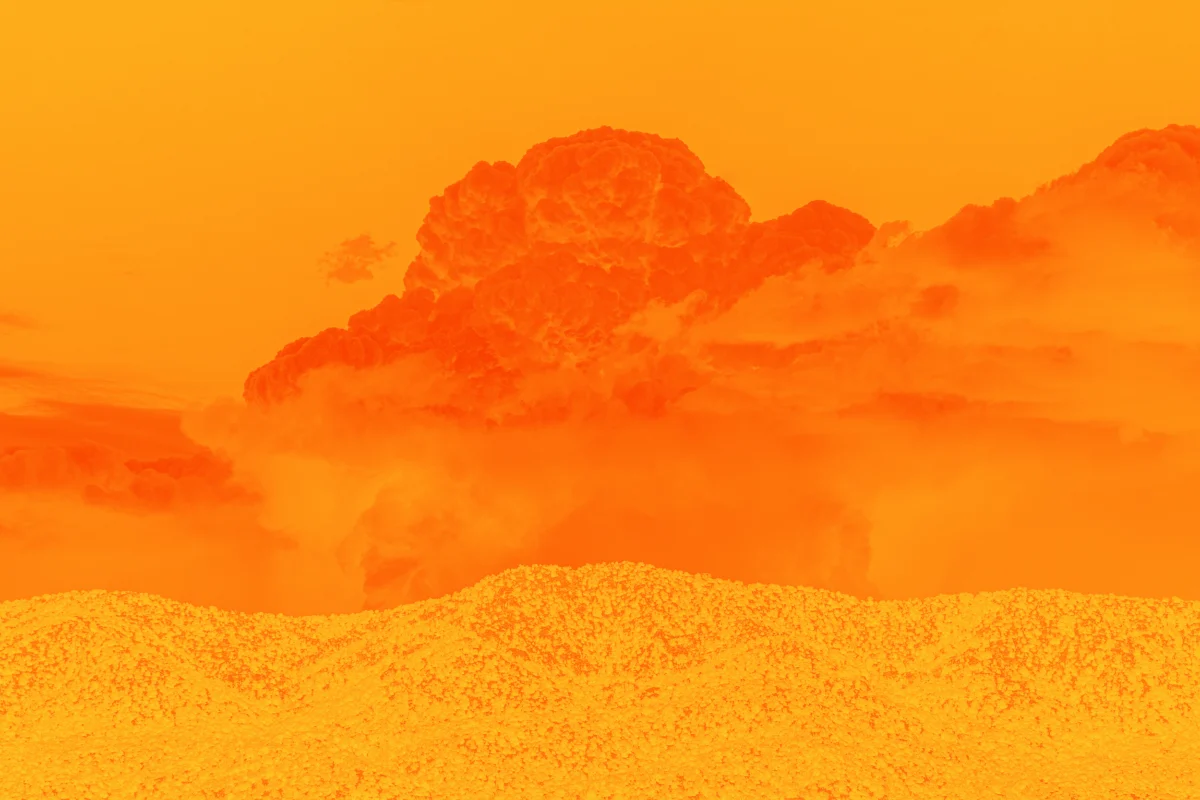
Beyond themes of presence and stewardship, the exhibition also addresses contemporary challenges facing New Mexico, including the profound impacts of climate change and the legacy of nuclear weapons testing. Michael Namingha, of Ohkay Owingeh and Hopi, presents "Disaster #8," a powerful piece where a vast cloud of smoke looms over a mountain landscape. While directly referencing the devastating Hermits Peak/Calf Canyon Fire of 2022, the largest wildfire in New Mexico’s history, the smoky plumes also evoke the chilling imagery of mushroom clouds, a stark reminder of the Trinity test detonation in 1945. Namingha’s work engages in a potent dialogue with O’Keeffe’s 1945 painting, "Red with Yellow," using a similar fiery palette to represent the Air Quality Index, thereby transforming O’Keeffe’s abstract exploration of color into a commentary on contemporary environmental and historical anxieties.

Several artists directly critique O’Keeffe’s historical framing of the landscape. In Jason Garcia’s "Tewa Tales of Suspense" series, presented as comic book-style clay tablets, O’Keeffe herself appears as a character. Depicted in her signature black wrap dress and hat against the backdrop of Ts’í P’ín, a sign behind her reads "Welcome to O’Keeffe Country." However, the name "O’Keeffe" has been deliberately scratched out and replaced with "TEWA," a bold and direct assertion of Tewa sovereignty over the land and its representation. These comic-style tablets, fired using traditional Pueblo pottery techniques, fuse ancient methods with contemporary storytelling to challenge established narratives.
The exhibition arrives at a critical juncture, as the national discourse surrounding historical narratives and cultural representation becomes increasingly polarized. The resurgence of overt nationalism and the rollback of diversity, equity, and inclusion initiatives in various sectors, including government and academia, underscore the urgency of this artistic intervention. For instance, the U.S. Department of Homeland Security’s use of John Gast’s "American Progress" painting with a quote echoing white nationalist sentiments highlights a broader trend of appropriating historical imagery to promote exclusionary ideologies. Concurrently, proposed federal budget cuts threaten funding for institutions that champion Indigenous studies and multicultural arts, such as the Institute of American Indian Arts in Santa Fe.
Despite these challenging sociopolitical currents, the "Tewa Nangeh/Tewa Country" exhibition embodies a commitment to a different path. Bess Murphy, the O’Keeffe Museum’s Luce Curator of Art and Social Practice and co-curator of the exhibition, articulated this vision: "We can and should do better and work from a place of care instead of violence, fear or racism." The collaborative spirit of the exhibition is paramount; the twelve featured artists were involved in every stage of its curation, from selecting which O’Keeffe works to include to writing their own exhibition texts. These narratives were then meticulously reviewed by Dr. Beverly Singer, an esteemed Indigenous anthropologist from Santa Clara Pueblo, ensuring an authentic and informed voice. A collaboratively developed map, detailing the six Tewa pueblos and featuring Tewa place names and ancestral villages, further reinforces this commitment to self-representation.

Ultimately, "Tewa Nangeh/Tewa Country" champions a framework for self-representation and community-led exhibitions, fostering nuanced and instructive dialogues about a region that has been too long defined by external perspectives. By centering Tewa voices and experiences, the exhibition not only reclaims a vital cultural narrative but also enriches the understanding of northern New Mexico’s complex history and its vibrant, living Indigenous present. It serves as a powerful reminder that for all her artistic renown, Georgia O’Keeffe was but one individual within the long and intricate continuum of Tewa Nangeh.