Rocky Georgio
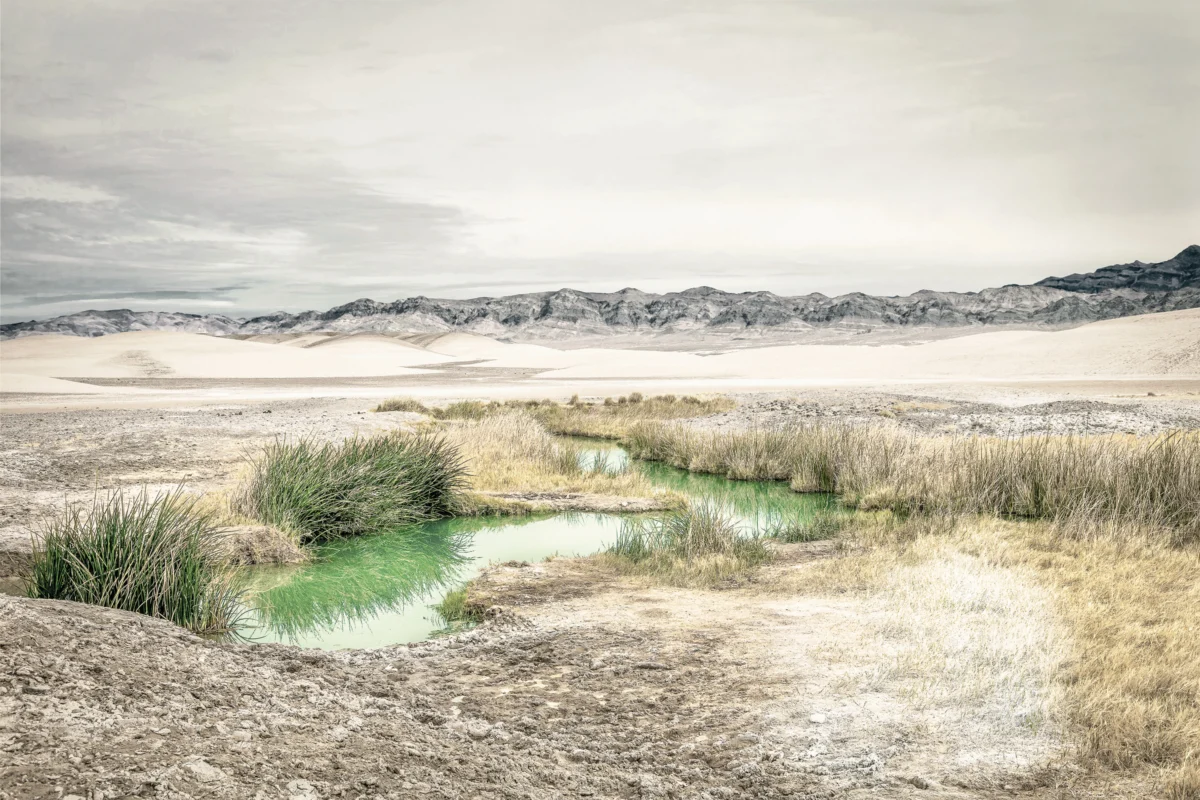
Desert springs, once vital arteries of life in arid landscapes, are now receding, their existence imperiled by a confluence of climate change and human activity. For millennia, these rare pools of water sustained ecosystems, guided human migration, and shaped the very fabric of settlement across the American West. They stand as living archives, holding deep wells of natural and human history within their limited perimeters, serving as crucial lifelines for biodiversity, cultural heritage, and hydrological systems that far outweigh their physical footprint. Yet, their gradual depletion often goes unnoticed, a subtle erosion of abundance that can be easily missed without a clear memory of what these places once were.

The delicate balance of these desert ecosystems is starkly illustrated by Borehole Spring in California’s Mojave Desert. An accidental oasis, it emerged when a borehole exploration punctured a pressurized aquifer, creating a haven that attracted migratory birds and supported a diverse array of wildlife. However, this accidental sanctuary now faces an existential threat from the intensifying drought gripping the region. Similarly, the Colorado Plateau in Arizona harbors Tappen Springs, a permanent water source that has historically served as a critical refuge for Indigenous tribes, local communities, and even historic cattle drives. Its continued viability is a testament to its ecological significance.

These springs are not merely geological features; they are deeply intertwined with human history and culture. In Nevada’s Black Rock Desert, Dyke Hot Springs, while offering modern tubs for a comfortable soak, stands on ground that has borne witness to Indigenous peoples’ use for 10,000 years, a testament to their enduring connection with these thermal waters. Further south, in Mexico’s Sonoran Desert, Alamo Spring offers a rare sight: a freshwater spring emerging at the edge of the saltwater ocean, creating small islands of life in a harsh environment. In Arizona’s Colorado Plateau, the Hanging Garden showcases groundwater seeping from cliff faces, nurturing vibrant colonies of mosses, ferns, and flowering plants, a miniature ecosystem sustained by hidden hydrological processes.

The scale of the loss is alarming. During a Hopi festival in Flagstaff, members of the Black Mesa Water Coalition shared poignant accounts of losing the springs their community relied upon, detailing the profound physical and cultural impact of this scarcity. Later, a spring ecologist revealed that since 1880, over 80% of the region’s springs have become ecologically impaired, a statistic that underscores the widespread nature of this crisis. This ecologist further noted that these seemingly small springs support more than 15% of the nation’s endangered species, highlighting their disproportionate importance to conservation efforts.

The quest to document these disappearing waters is often a journey of human connection and chance encounters. The photographer’s journey to find springs frequently relies on a network of strangers, ranchers, and landowners, as much as on database research. One such instance involved a landowner in the Black Rock Desert who, despite never meeting in person, provided crucial directions to various springs via text messages, fostering a unique exchange of images for guidance. This collaborative approach underscores the localized and often personal nature of understanding and protecting these vulnerable resources.

The historical significance of these springs extends to places like Corn Creek Springs in Nevada’s Mojave Desert. This site, historically and culturally important to Native Americans and later European settlers, now lies within the restricted boundaries of the Nevada Test and Training Range, a stark reminder of how human development can impact sensitive ecological areas. In Utah’s Colorado Plateau, Liston Seep, once utilized for watering cattle, was eventually abandoned after the animals were moved, illustrating how changing land use patterns can lead to the neglect and potential demise of vital water sources.

In New Mexico’s Chihuahuan Desert, Mirror Lakes, deep spring-fed sinkholes, are slowly shrinking. This decline is attributed to agricultural overpumping, which is depleting the region’s hidden water table and drying up these ancient desert oases. This phenomenon is mirrored at Devil’s Inkwell in the same state, an ancient deep-water cenote fed by underground springs that currently attracts scuba divers, showcasing a different facet of spring utilization. Even in seemingly barren regions, springs can create unique geological formations, like the hyper-saline, extremely hot waters of East Pinto Hot Springs in Nevada’s Black Rock Desert, which hold potential for discovering new medicinal compounds, building upon the 6,000-year history of use by the Indigenous Shoshone and Paiute peoples.

The artistic representation of these springs aims to bridge the gap between scientific data and emotional connection. By slightly desaturating the surrounding arid land and subtly brightening the springs themselves, the visual narrative emphasizes the stark contrast between the parched environment and the life-giving water. This approach, inspired by naturalist Alexander von Humboldt’s philosophy, seeks to cultivate an emotional resonance with nature that pure data alone cannot achieve. The photographs serve as a testament to what remains, a visual memory to cherish.

The process of losing these vital water sources can be insidious. At a desert spring, the silence where frogs once croaked can become the norm. This generational shift in perception is a significant concern: each new generation is born into a reality of scarcity compared to the last, accepting it as the natural state and remaining unaware of the lost abundance of the past. The "Hidden Waters" project aims to serve as a witness to this ongoing environmental narrative, documenting these changes and refusing to let these precious ecosystems fade into quiet absence.

The long journey of groundwater, taking millennia to travel and replenish deep basins, is being disrupted by modern practices. In California’s Mojave Desert, Willow Creek exemplifies this issue, where ancient groundwater is extracted far faster than nature can replenish it, leading to the drying up of springs. Similarly, Dairy Spring on Arizona’s Colorado Plateau, once crucial for Mormon pioneers in the late 1870s and 1880s to support a cooperative dairy, now faces the broader challenges threatening all such water sources.

The enduring legacy and current plight of these hidden waters underscore the urgent need for conservation and a deeper understanding of their ecological and cultural significance. The project "Hidden Waters" stands as a powerful reminder that these seemingly small, remote springs are integral to the health of the planet and the preservation of both natural and human heritage. Their continued existence depends on our collective awareness and action.