Rocky Gerung
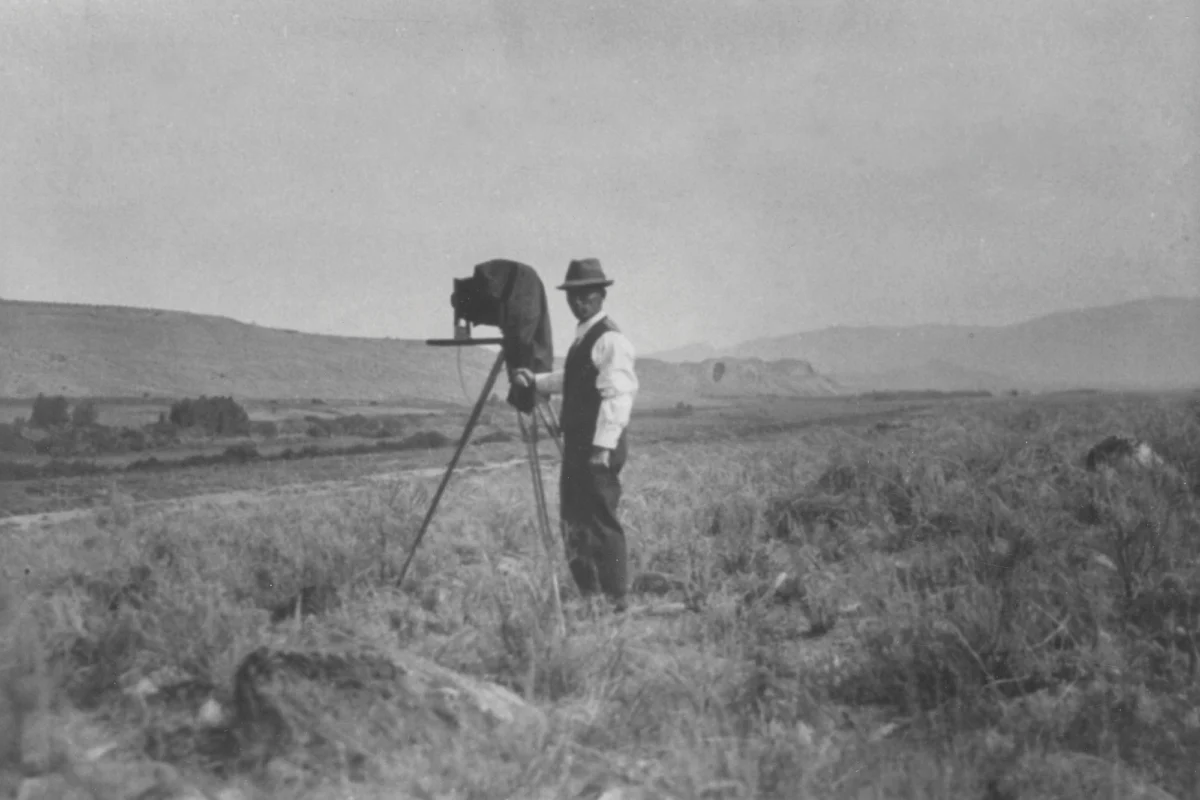
Filmmaker Beth Harrington’s discovery of Frank Matsura’s photography at the Washington State History Museum in 2002 was a serendipitous encounter that ignited a decades-long passion. While exploring an exhibit of Edward S. Curtis’s work, Harrington was captivated by the distinct character of photographs by one of Curtis’s lesser-known contemporaries, Frank Matsura. This initial spark led Harrington to create "Our Mr. Matsura," a feature-length documentary delving into the life and enduring legacy of a Japanese immigrant photographer who profoundly documented the people and landscapes of Okanogan County, Washington, between 1903 and 1913.
Matsura’s black-and-white images possess a remarkable intimacy, reflecting his deep connection with his subjects and his own charismatic presence. Unlike the often formal and detached approach of some photographers of his era, Matsura frequently included himself in his photographs, often posing playfully alongside the diverse individuals he encountered. His subjects ranged from white settlers establishing new lives in the burgeoning town of Okanogan to Indigenous people of the Colville Indian Reservation, capturing a period of significant cultural and societal transformation. He worked in Okanogan County for a decade, leaving behind thousands of images, before succumbing to tuberculosis at the young age of 39. Despite the scarcity of biographical documentation, Matsura’s work has resonated deeply with the communities he depicted, who remember him with enduring affection.

Harrington, who moved to the Northwest from Boston in the early 2000s, spent nearly twenty years piecing together Matsura’s story. The title of her documentary, "Our Mr. Matsura," reflects the collective sense of ownership and familiarity that the communities feel towards him. "Everyone thinks they have a little window into who he is," Harrington explained, "and there’s a collective sense of who he is because of those little impressions." This sentiment was palpable at a recent screening of the film at the restored Omak Theater, where an audience of approximately 300 gathered to celebrate Matsura’s enduring impact.
Douglas Woodrow, a lifelong resident of Okanogan, shared how Matsura’s photographs were a constant presence throughout his childhood. "The local newspaper would post pictures of the past, usually by Frank Matsura," he recalled. As a young boy in the late 1950s, Woodrow would bike to the locations depicted in these historical images, struck by the passage of time and the changes wrought upon the landscape. He vividly remembered imagining the majestic three-story Bureau Hotel, which tragically burned down in 1924, as a beacon of "elegance in an otherwise dusty little town."
Woodrow’s connection to Matsura deepened when he returned to Okanogan decades later and began volunteering with the Okanogan County Historical Society. His most significant discovery was a "literal shoebox" filled with unprocessed Matsura photographs. When sequenced, these images revealed the construction of the Conconully Dam in 1910, an early Bureau of Reclamation project on Salmon Creek. This project ignited a new wave of enthusiasm for Matsura’s work, leading Woodrow to present these historical photographs to community groups.

His dedication to preserving Matsura’s legacy extended internationally. Woodrow, accompanied by his friend and fellow enthusiast Tetsuo Kurihara, a Japanese photographer who initially met Woodrow during a research trip to Okanogan, traveled to Matsura’s birthplace in Tokyo. Back in Washington, Woodrow spearheaded efforts to honor Matsura, including the installation of an interpretive site near the photographer’s former studio and the creation of a walking tour featuring mural-sized reproductions of his photographs.
Woodrow emphasized Matsura’s extraordinary social mobility and his ability to transcend societal boundaries. "He was included in just about everything that happened in town, by all the social strata," Woodrow observed, highlighting Matsura’s seamless integration into the lives of tribal members, new white businessmen, miners, and saloon patrons alike. This inclusive approach allowed Matsura to capture a nuanced and comprehensive portrait of Okanogan County during a pivotal era.
Randy Lewis, a Wenatchi (P’Squosa) elder and member of the Confederated Tribes of the Colville Reservation, is among the many descendants of Matsura’s subjects featured in "Our Mr. Matsura." Lewis has been actively involved in community screenings of the film, including a unique "barn screening" in Winthrop, Washington, followed by a traditional salmon bake. His family history serves as a poignant example of how the world Matsura documented continues to live on. The film prominently features a photograph of Lewis’s great-uncle, Sam George, with his family in a buckboard wagon, which Lewis likened to "the F-250 of the time." He shared that this photograph was a treasured possession in his family home during George’s final years.

Lewis recounted how his great-uncle would gaze at the photograph, using it as a mental anchor to recall the names and birthdays of everyone in the wagon, a testament to the photograph’s enduring power and connection to his past. Sam George lived to be 108, his life spanning a period of immense change for Indigenous peoples in the region. Born in 1860, predating the establishment of the Colville Indian Reservation in 1872, he witnessed its reduction, the controversial allotment era, and the influx of gold-seekers and homesteaders. His family, like many others, maintained traditional seasonal fishing practices, including a platform at Celilo Falls, a vital fishing ground on the Columbia River. This ancestral practice was tragically disrupted when the construction of The Dalles Dam in 1957 inundated the site, destroying one of the continent’s richest fishing grounds.
Matsura arrived in the region during a profound cultural shift, a time when both Native and settler cultures were undergoing significant evolution. As Lewis aptly put it, "We were into a new century, and he was capturing that. It wasn’t the death toll of the Indians. It was life going on." Matsura’s lens focused on the vitality and continuity of life amidst these dramatic societal changes.
"Our Mr. Matsura" also serves as a rich portrait of Okanogan County itself, highlighting the isolated and rugged beauty of a landscape that has remained remarkably similar to the one Matsura encountered over a century ago. Jean Berney, a long-time rancher and farmer residing near Conconully, described the area as "off the beaten track for a lot of people." An enrolled member of the Colville Confederated Tribes, Berney married into a non-Native cattle-ranching family and built her own successful herd, earning national recognition as a conservation-minded rancher and a dedicated supporter of the 4-H program.

Berney’s property once housed the Conconully Naturpathy Institute, more commonly known as Casselmann’s Sanitarium, where a German immigrant named Casselmann treated tuberculosis patients beginning in 1906. It is widely believed that Matsura may have been a patient at this institution, with the region’s dry climate potentially being a factor in his decision to settle there. Berney often muses about Matsura’s experiences traversing the rugged terrain. "Did he ever talk to Dr. Casselmann about his condition? How long was he sick? We wonder about Frank and everything that happened a long time ago, and we can’t ask," she shared, expressing the poignant sense of loss that comes with the passage of time and the fading of firsthand accounts.
Harrington’s documentary joins a growing body of work dedicated to preserving Matsura’s artistic legacy. This includes the tireless efforts of volunteers at the Okanogan County Historical Society and the academic contributions of Michael Holloman, a tenured art professor at Washington State University. In 2023, Holloman co-curated a significant exhibition of Matsura’s work for Spokane’s Northwest Museum of Arts and Culture, followed by the publication of his book, "Frank S. Matsura: Iconoclast Photographer of the American West," in 2025.
Holloman, himself an enrolled member of the Confederated Tribes of the Colville Reservation, sees a vital lesson in Matsura’s life and work for contemporary society. "We need people to be like Frank right now," he stated, "to engage multiple communities and be able to find life, vibrancy, in a world that is in transformation and change." Matsura’s ability to bridge cultural divides and capture the essence of human experience in a rapidly evolving world offers a powerful model for connection and understanding in the present day.

The planned wide release of "Our Mr. Matsura" on PBS’s "The American Experience" was unfortunately affected by federal funding cuts that led to the discontinuation of the long-running series. Despite this setback, Harrington remains optimistic that the film will find its audience through film festivals, streaming platforms, and special screenings like the one held in Omak. She acknowledges that the path forward will be more challenging, but emphasizes the profound value of these stories. "There’s a lot of worthy things that we can’t put a dollar value to," Harrington reflected, "These stories… we’re poorer for them when we don’t have them."
During the Omak screening, Harrington received heartfelt thanks for "mirroring" the trust and connection that Matsura had cultivated with his subjects over a century prior. However, the filmmaker was quick to return the sentiment, underscoring that the narrative extends beyond Matsura himself. "The story is not just about Frank and his charisma and his incredible body of work," she stated. "It’s about the way people uphold his memory and still talk about him 112 years after his death." This enduring legacy is a testament to the profound human connections forged through art and shared history, a legacy that Frank Matsura, the enigmatic photographer of the American West, continues to inspire.