Johny Prima
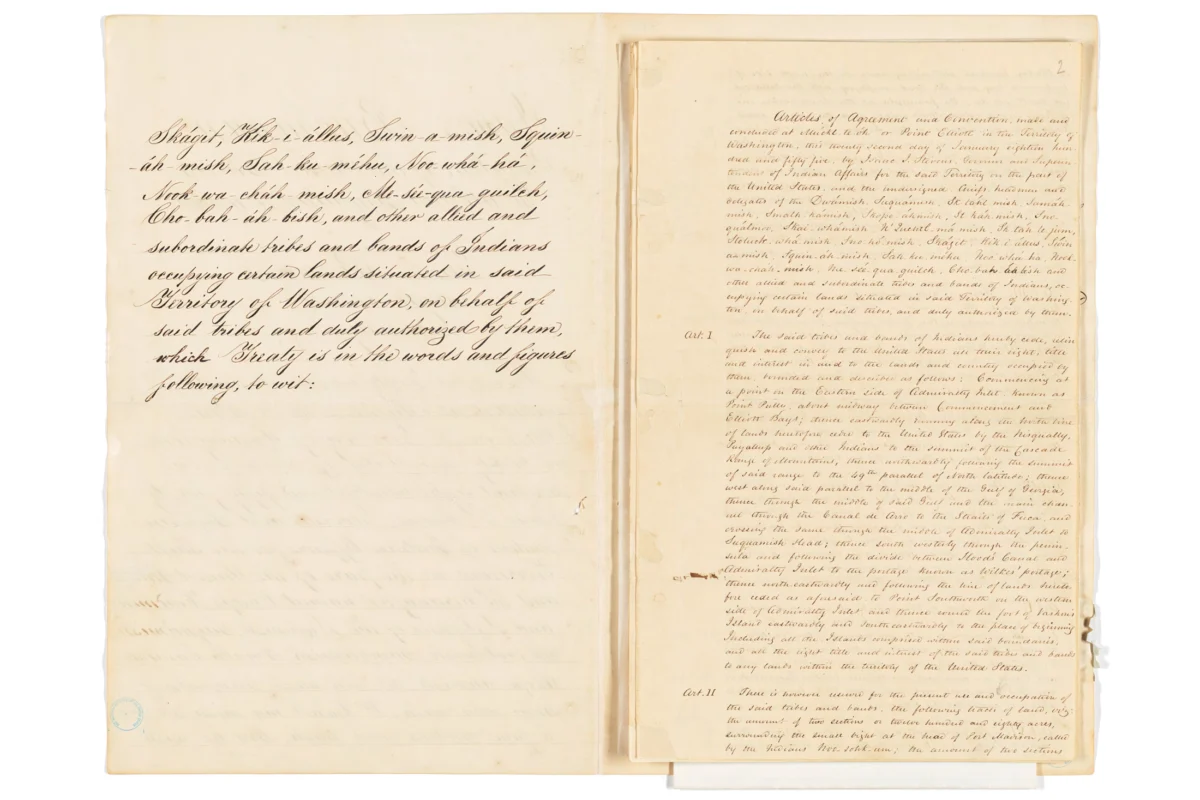
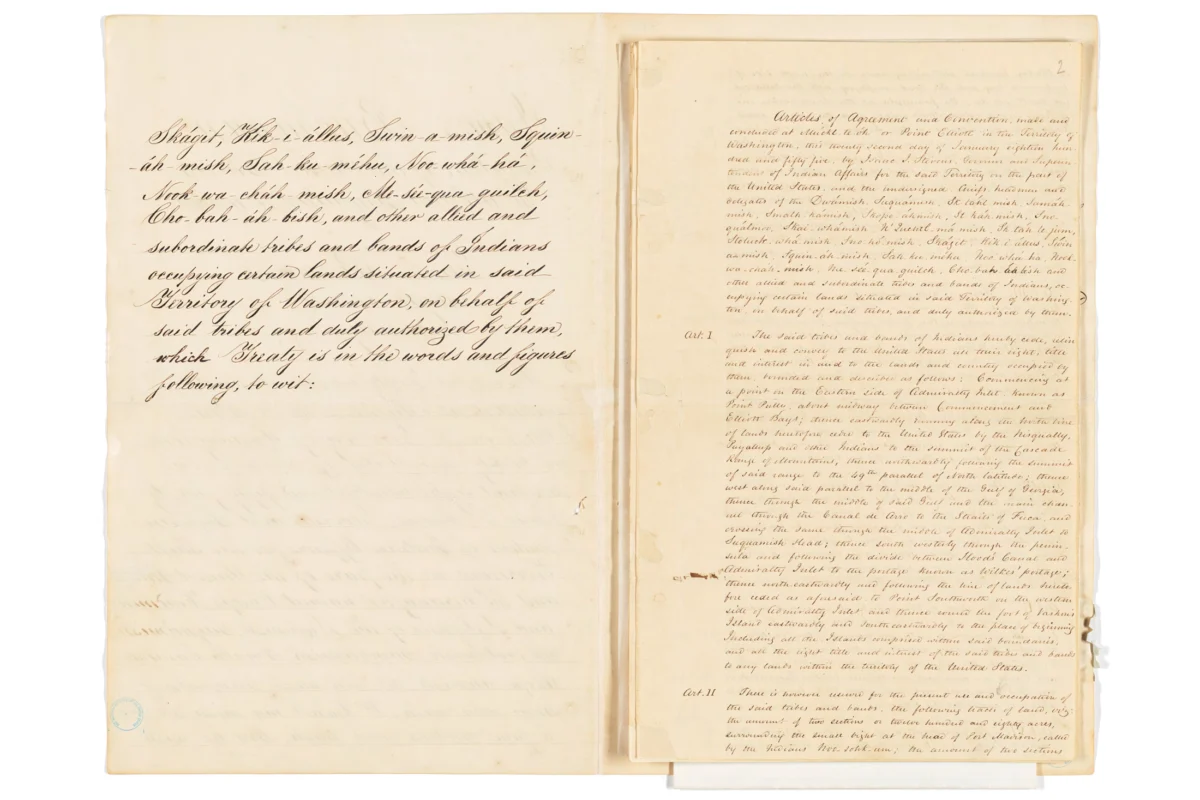
The seminal 1855 Treaty of Point Elliott, which meticulously defines the intricate political relationship between the nascent United States and more than 20 Pacific Northwest tribal nations, traces its profound origins to a moment of devastating cultural collision in 1792. That year, a young Duwamish and Suquamish boy, known as siʔaɫ (pronounced "See-alt") and later revered as Chief Seattle, bore witness to the arrival of foreign invaders. From the vantage point of his village, a vibrant community of thousands, perhaps tens of thousands, of relatives according to contemporary Suquamish tribal accounts, he observed a ship laden with disease anchor in what is now known as Miller Bay, Washington. The English captain, incapable of communicating in any of the region’s diverse Indigenous languages, represented the vanguard of an inexorable colonial expansion that would irrevocably alter the landscape and its people. Sixty-three years later, the boy had matured into the esteemed Chief Seattle, but the intervening decades had exacted a horrific toll. Only 272 Suquamish people remained, decimated by introduced pathogens and the relentless encroachment of settlers who had by then established their own territorial government. In this stark new reality, a formal treaty emerged as perhaps Chief Seattle’s sole recourse to negotiate enduring protections for his beleaguered descendants and their ancestral lands.
"Chief Seattle signed that treaty with the government after witnessing so many deaths that he had to be looking out for survival for future generations," affirmed Rob Purser, a Suquamish tribal member and director of treaty rights for the Suquamish Tribe. "There wasn’t no way of fighting your way out of that problem." Faced with overwhelming odds and the existential threat to their very existence, Indigenous leaders made the pragmatic, albeit painful, decision to engage with the colonial government, exchanging promises for land cessions. Yet, the foundational principles of these agreements—intended to be perpetual covenants—are routinely challenged, ignored, or reinterpreted by non-Native governments, mirroring the power imbalances of Chief Seattle’s era. This dynamic fuels an ongoing, complex dialogue involving the wisdom of Native ancestors, the rigorous scrutiny of U.S. courts, and the persistent advocacy of contemporary tribal nations.
The very act of negotiation for the Treaty of Point Elliott was fraught with peril, requiring multiple layers of interpretation that inevitably led to convoluted final translations. English statements were first rendered into Chinook Jargon, a regional trade language with a functional but limited vocabulary, before being further translated into local languages such as Muckleshoot and Lushootseed. This linguistic chain created ample opportunity for misunderstanding, misrepresentation, and the subtle distortion of crucial concepts. Despite these challenges, over 80 Indigenous leaders affixed their marks to the document, which today underpins a vast array of rights and responsibilities, influencing everything from tribal fishing allocations and natural resource management to provisions for education and medical care. The Suquamish Tribe, recognizing the treaty as a living testament to their sovereignty, has steadfastly defended its provisions before the U.S. Supreme Court an astonishing nine times, prevailing in every instance. Purser credits these victories to "Chief Seattle’s wisdom, looking at the situation his people were under, to try to protect future generations."
The fundamental disconnect between Indigenous and settler worldviews profoundly shaped the treaty’s interpretation from its inception. Joshua L. Reid (Snohomish), a distinguished history and American Indian studies professor at the University of Washington, highlights this divergence: "Coast Salish peoples had, and continue to have, different ideas of what constitutes property, what constitutes ownership. Simply put, it’s more a system where people belong to places rather than people own places in that fee simple property way that United States property concepts observe." This profound philosophical difference meant that while Indigenous peoples understood negotiations and treaties—having knowledge of the Douglas Treaties signed by British colonial governors with First Nations around Vancouver Island—their interpretation of "reserving certain things" and "extending certain rights" was fundamentally different from the Western notion of outright land cession.
Andrew Gobin (Tulalip), director of treaty rights for the Tulalip Tribes, powerfully articulates the comprehensive scope of these Indigenous understandings. "Our people saw what was coming, and they had the wisdom and the foresight to protect the things that are important to our people in our way of life, because truly, our entire culture is protected in the treaty. The rights to hunt, fish and gather protect everything." He explains that "usual and accustomed places" are not merely geographical points but encompass ancestral family village sites, thereby safeguarding "bloodline, heritage," and preserving intergenerational oral traditions passed down through practice. "When you look out at the land and water, you see every aspect of our culture." These treaty rights, Gobin stresses, represent "knowns: We know what is obligated, we know what is protected." Yet, he laments, "if the tribes weren’t there to stand up and voice the concern, then [federal agencies] just move forward like [the treaty] doesn’t exist."
Rob Purser underscores a critical, often misunderstood point: "The government didn’t give us nothing. No tribe got gifts from the government. We reserved those treaty rights in exchange for land. And that’s the same all across the U.S." This crucial distinction highlights that treaties are agreements between sovereign nations, not handouts. The urgency of securing these agreements was not lost on Washington Territory Governor Isaac Stevens, who spearheaded the negotiations. Professor Reid notes, "There were still, demographically, many more Indigenous peoples here than settlers at the time of the signing of the treaties… There were plenty of times that Natives successfully fought back or chased settlers out of these homesteads that they were laying claim to." This demographic reality "loomed large in Stevens’ mind, because he knew that if Native nations banded together, they could push the settlers out. He had real motivation to try to get these treaties negotiated and signed to prevent something like that from happening."
However, the power dynamic inherent in these negotiations allowed the United States to disregard key promises. Oral histories collected in the 1920s from elders who were children or young teens at the Mukilteo treaty grounds consistently recount Stevens’ promise of a vast reservation in western Washington, one so expansive that every Coast Salish man, woman, and child would receive 80 acres. "So Native peoples were like, ‘OK, this is a clear statement of protecting our land rights,’" Reid explains. Yet, this pivotal promise, reiterated by dozens of Coast Salish peoples in their depositions, "doesn’t appear anywhere in the negotiation notes. That’s one of those examples of the power dynamic at play—that the United States was powerful enough to ignore some of these key promises that were made in the negotiations." This systemic failure to honor commitments continues to fuel contemporary disputes and underscores the historical inequities embedded within the treaty process.

One of the most fiercely contested and legally significant aspects of the Treaty of Point Elliott concerns fishing rights, particularly the phrase allowing tribes to fish "in common with all citizens of the Territory." In a landmark 1974 decision, U.S. District Court Judge George H. Boldt famously interpreted this phrase to mean that treaty tribes retain the right to harvest 50% of the fish in Washington state. Judge Boldt wrote, "There is no indication that the Indians intended or understood the language ‘in common with all citizens of the Territory’ to limit their right to fish in any way. For many years following the treaties the Indians continued to fish in their customary manner and places, and although non-Indians also fished, there was no need for any restrictions on fishing." This pivotal ruling, often referred to as the Boldt Decision, reaffirmed tribal sovereignty and co-management responsibilities over fisheries. Yet, the exact boundaries of a tribe’s "usual and accustomed" fishing grounds remain a subject of ongoing legal debate, as evidenced by recent cases. This year, the Quinault Tribe sought expanded access to fishing grounds in Western Washington, asserting they fall under their "usual and accustomed" purview, while in 2021, the Sauk-Suiattle Tribe initiated legal action to prevent neighboring tribal nations from fishing the Skagit River, arguing it lies outside their traditional areas.
The profound philosophical chasm regarding natural resources, particularly fish, also contributed to historical misunderstandings. From Governor Stevens’ perspective, "fish didn’t become property until you caught it and brought it into your boat or net," Professor Reid explains. In stark contrast, "from Indigenous perspectives, fish were people. They were more-than-human people who were part of the larger community of the Salish Sea." This meant fish were not simply property to be exploited but entities that "gave themselves to Coast Salish peoples, because of these reciprocal relations, protocols of respect." The belief was that if salmon were not respected, they would disappear. Consequently, elaborate protocols and management structures were in place for the proper treatment of salmon. "From a Coast Salish perspective, fishing isn’t just the simple act of putting a fishing pole in the water and yanking a fish out. Fishing included all those protocols, the reciprocity, the preparation that went into it and all the management structures." When Stevens’ assurances that "this paper secures your fish" were clumsily translated into Chinook Jargon, Coast Salish leaders understood it to encompass this entire complex web of relationality, management oversight, and respect. This fundamental disjuncture in understanding continues to shape modern resource co-management challenges. Andrew Gobin further illuminates this cultural depth, noting, "Our language is verb-based. The parts of our language are tied to specific actions or something that happens. The word that we use for salmon is tied to something that happens every year…how that translates across our culture is that the times of the year are specific to where we are in that cycle of salmon."
Rob Purser rightly identifies the Boldt Decision as "the biggest positive court decision in Indian Country, period." It took an "old treaty"—which many at the time argued was outdated and no longer relevant—and, through Judge Boldt’s ruling, recognized it as a "living document," making it the supreme law of the land. "And what that did is that brought back to life all treaties across the U.S. that were signed. Their federal court said that those are living documents and they need to be upheld." This precedent has reverberated across the nation, affirming the enduring constitutional weight of treaties and tribal sovereignty.
However, the modern era introduces new complexities. Andrew Gobin points to climate change as an emerging threat to treaty rights. "These are the types of things that we deal with in policy, how these historic agreements move into current events, ongoing issues, and emerging issues." He explains, "Our rights are place-based. Our rights, preserved under the treaty, exist in our usual and accustomed places. Well, with sea-level rise, we get displaced of our usual and accustomed places, or with our land-based rights, which are on open and unclaimed lands. As environments shift, our people get displaced. Or as development happens, wildlife populations are displaced, and if they move outside of areas reserved under the treaty, then they become inaccessible." These environmental shifts demand innovative interpretations and proactive measures to ensure treaty promises remain viable in a rapidly changing world.
Even seemingly universal concepts like "family" and "friendship" were subject to radically different interpretations during treaty negotiations. Professor Reid explains that from an Anglo-American perspective, the "Great Father" (referring to the U.S. president) wielded paternalistic power over his "children." From an Indigenous perspective, however, "that father only can exercise that power if he takes care of his children." When Chief Seattle acknowledged the "Great Father," Governor Stevens misinterpreted this as submission. In reality, "Chief Seattle was actually bringing the president of the United States and other U.S. officials into the larger political family of Coast Salish peoples, and that came with all kinds of rights and responsibilities that the United States just blindly ignored in subsequent generations." Similarly, "friendship" within a Coast Salish context implied a network of relationality where "you’ve got rights and responsibilities, you feed your friends, you support your friends, you ally with your friends. You don’t take their lands, screw them over, and shoot them dead." This fundamental misunderstanding of reciprocal duties tragically paved the way for broken promises and ongoing injustices.
Among these unfulfilled promises are basic provisions for social infrastructure. Rob Purser states, "The promise of a school and a clinic is definitely what was in the treaty. That’s not what happened. We had to buy our own school. We’re buying our own medical facilities. None of that was ever provided." This systemic failure to uphold treaty obligations places an enormous burden on tribal nations, forcing them to expend their own resources to secure services that were legally promised. Anthony Hillaire (Lummi), chairman of the Lummi Nation, forcefully asserts, "In our efforts to take care of ourselves, in no way do we ever or will we ever let the United States of America off the hook of their treaty and trust responsibility to us." He emphasizes the ongoing necessity for tribes "to do the work to ensure that they’re following their own law," highlighting persistent failures in healthcare, education, salmon recovery, and the co-management of natural resources.
The U.S. Constitution, in Article 6, unequivocally states that treaties are the "supreme law of the land." Yet, a pervasive misunderstanding persists among many non-Natives who "assume that treaties were a figment of the past and are best kept in the mid-19th century," as Professor Reid observes. "But from Indigenous perspectives, that’s not at all what a treaty is. A treaty is something that, of course, was negotiated and signed at that place in time, but that it brought the United States and non-Natives into perpetual relations with Indigenous peoples, and that actions need to happen to continuously maintain them." These two radically different understandings underscore the ongoing tension. Lisa Wilson, a Lummi Tribal Council member, powerfully articulates this Indigenous perspective: "Treaties are for all of us. They aren’t just for Indian people in western Washington. The treaties bind all people, Native and non-Native, together around these ideas of relationality, of how to interact with each other."
Defending these treaty rights today remains an "everyday challenge," according to Rob Purser. A significant hurdle is the persistent "lack of knowledge, the lack of education" among the general public and even within governmental agencies. "People moving in [to our area] know nothing about tribes." He recalls how the Boldt Decision era was plagued by "so much misinformation put out about tribes and treaties and Indians," and tribal nations are "still dealing with that misinformation." While there is a growing segment of the population that understands and empathizes with Native struggles, a substantial portion remains uninformed. Purser’s department, which operates on a government-to-government basis, faces a continuous cycle of educating new officials. "They retire. They work 40 years, retire, and they hire new people and we start all over, educating them on treaty rights. Everyone that comes in has to learn all about the treaty rights and Natives." This perpetual need for education highlights the fundamental and ongoing work required to ensure that the supreme law of the land is not only understood but truly honored, fostering a future built on respect, equity, and the fulfillment of promises made generations ago.