Roger Danuarta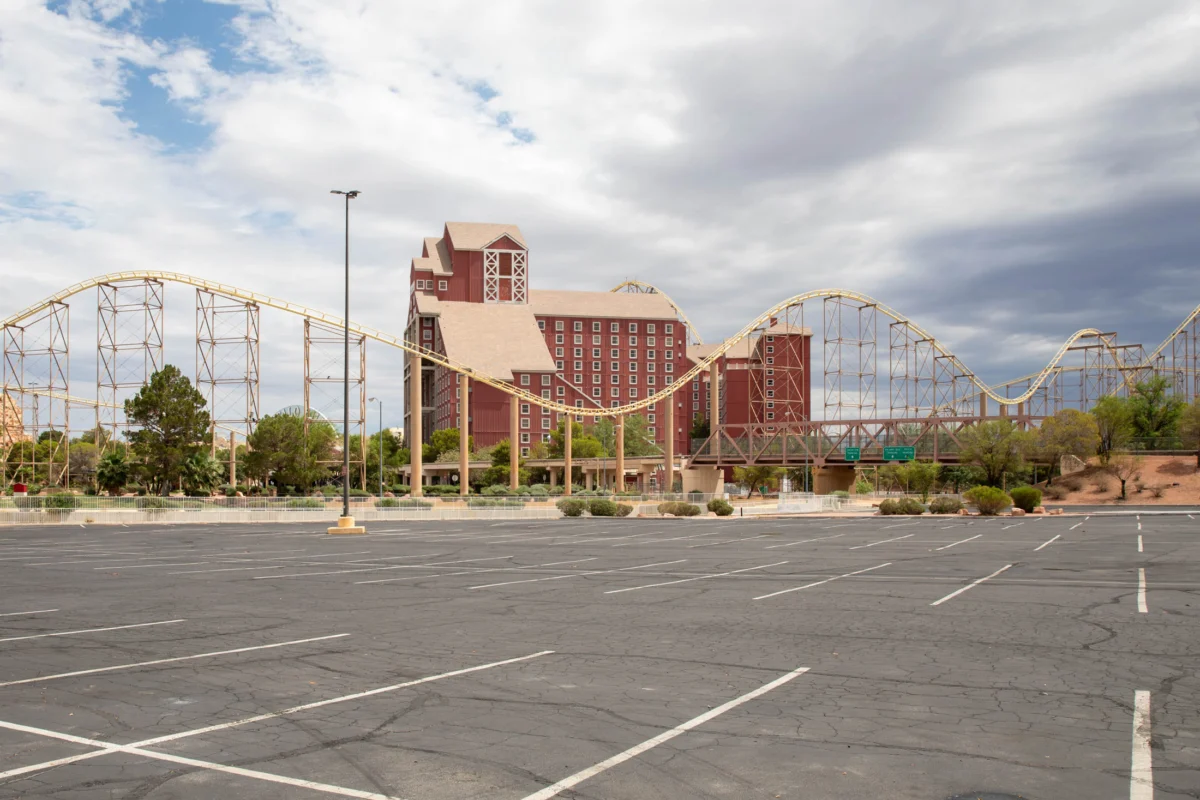
On what many believed to be its final Saturday night, June 27, the Primm Valley Resort & Casino, a venerable beacon on the Nevada-California border, braced for an imminent shutdown. Melrose, a dedicated employee with 31 years of service at the last operational casino in this unique Mojave Desert company town, moved with a protective air across the dimly lit gaming floor. Her signature curly hair framed a face bathed in the warm magenta glow of the few active machines, her all-black uniform and oversized cash belt a testament to decades spent navigating the ebb and flow of fortune. "People do all sorts of crazy stuff to the machines when they lose money," she remarked, her voice a stoic counterpoint to the quiet whirring and infrequent chimes. The once-bustling hall, designed for thousands, now hosted a mere thirty souls, a stark tableau of decline.
More than half of the casino games had already been silenced, their screens dark and inviting no further play. Only one bar offered solace, and the Bonnie & Clyde Diner’s menu had been stripped down to a minimalist offering of pizza and hot dogs. The escalators, once a symbol of the resort’s vibrant energy, had remained dormant since 2020, a silent monument to diminishing aspirations. Primm Valley stood alone that night, the last vestige of a once-thriving roadside empire. Its neighbors had long succumbed: Whiskey Pete’s, with its distinctive castle motif, had closed its casino floor in 2024, though its gas station clung to life. Buffalo Bill’s, a Western fantasy mining resort complete with towering roller coasters, had seen its thrill rides grind to a halt the previous summer. The amenities across Primm had dwindled in tandem with its crowds, culminating in the Prizm Outlets, a sprawling retail complex that once boasted a hundred stores, now reduced to a single, solitary shop.
Amidst the quiet decay, Top 40 music played a touch too loud, an almost desperate attempt to mask the silence, to fill the vast emptiness. Melrose, rocking gently on her heels, repeated a mantra: "Everything is going to be OK." Maintenance workers moved methodically, wiping down buttons that had not felt the touch of a gambler’s hand in years, a futile gesture against the encroaching stillness. Since the global pandemic upended travel and entertainment patterns, Primm’s casino floors had rarely seen the vibrant crowds of yesteryear. Yet, the official announcement on May 5 from Affinity Interactive, the mid-sized regional gaming and hospitality company that had owned Primm’s properties since 2011, still sent a shockwave through the small community. The company declared a full cessation of operations by July 4, encompassing the resort, casino, two gas stations, travel centers, and the Lotto Store. For the more than 300 employees residing in the Desert Oasis Apartments, this meant a frantic 60-day scramble to secure new housing and employment.

Karine Fersch, a resident of Desert Oasis and an employee at Sanithrift, the lone survivor in the Prizm mall, articulated the collective panic. "I was really panicking, because I didn’t know where to go," she confessed, reflecting on her nine years in Primm. She recalled a brighter past, a time when "tourists from around the world, Californians, people in Nevada" flocked to the town, making it "really busy." Even the golf course where she once worked had been abandoned in 2025, its verdant fairways surrendered to the desert sun, now parched and brown.
For three agonizing weeks following Affinity’s declaration, a desperate effort unfolded to avert Primm’s demise. Social media buzzed with speculation and outrage, one TikTok user observing, "Everyone pretends that it’s the owners taking all the risk." Regulars, gripped by a sense of finality, rushed to play one last game, some even leaving money and farewell notes in the glass-enclosed exhibit housing Bonnie Parker and Clyde Barrow’s infamous bullet-riddled car. A cashier named Lenoir at the Primm Center, a gas station with a dedicated slot room, whispered rumors of MGM’s potential acquisition, a beacon of hope in the gathering gloom. Then, at what felt like the very last moment, a miracle materialized: Primm would, against all odds, remain open. However, for those whose lives and livelihoods were entwined with the town, the precise meaning of this reprieve remained shrouded in uncertainty.
Primm, originally christened "State Line" due to its precise geographical location straddling the Nevada-California border, adopted its current name in 1996, honoring the family who began developing its cluster of themed casinos in 1950. Throughout the 1990s and early 2000s, this desert outpost served as a vital gateway, a final, enticing stop for millions of travelers journeying between Southern California and the dazzling lights of Las Vegas along a desolate stretch of highway. The casinos, with their whimsical themes and roadside allure, embodied an older, more theatrical era of American entertainment, where gambling was merely one facet of an immersive, destination-driven experience. The ownership of Primm’s properties changed hands multiple times before Affinity Interactive, a company focused on regional gaming and hospitality, assumed control in 2011.
"This place was spectacular," lamented Robert, a visitor from Las Vegas, as he meticulously captured images with a film camera in the parking lot of Buffalo Bill’s. An artificial mountain, a relic of a grander vision, rose improbably from the asphalt, while wind-tattered signs still pointed towards the neighboring resort, proclaiming: "The Party is at Primm Valley." Though Buffalo Bill’s had been closed for a year, a peek through its glass doors revealed active, flashing game screens in the empty room, a ghostly echo of past revelry. A passing security pickup, indifferent to Robert’s presence, underscored the sense of abandonment. Robert, reflecting on the employees’ predicament, posed a rhetorical question: "Would you care after your boss laid you off and kicked you out of your house, with two weeks left of work?" His words resonated with the palpable anxiety that had gripped the community.

The Primm family, who continued to hold the crucial land leases beneath Affinity’s properties, publicly condemned Affinity’s decision, recognizing its devastating implications for the entire town. Cory Clemetson, grandson of founder Ernie Primm, issued a statement expressing the family’s profound disappointment: "We hoped that the operators could have done more to ensure the continued operation of the hotel-casino and related properties. We were also disappointed that we weren’t given much notice before this announcement." This condemnation highlighted the inherent vulnerability of company towns, where a single corporate entity’s decisions can dictate the fate of an entire population, impacting not just jobs but homes and community infrastructure.
Crucially, the land beneath Affinity’s buildings remained under the Primm family’s ownership. On June 9, in a move that would prove to be Primm’s salvation, the family forged an agreement with Terrible’s, a prominent chain of gas stations and travel centers owned by the Herbst family. This pivotal deal not only ensured the continued operation of Primm Valley Resort but also promised a much-needed facelift for the town, including the reopening of Buffalo Bill’s on weekends for concerts and events. Critically, apartment leases for employees would not be terminated, and workers would retain their jobs, a lifeline for hundreds facing displacement.
The Herbst family, through their "Terrible’s" brand, possesses deep roots in this particular stretch of desert, their distinctive establishments long integrated into Nevada’s roadside landscape, offering travelers fuel, rest, and a chance to try their luck at the slots. Their intervention in Primm echoes a pattern seen elsewhere in the region. Towns like Primm have long teetered on the precipice of becoming ghost towns, casualties of shifting economic winds and evolving travel habits. Nearby Jean, for instance, a town just north of Primm, lost its long-standing casino, Nevada Landing, in 2007. It was subsequently demolished for a planned community that never materialized, leaving Jean largely defined by an airport, a post office, a terracotta-colored prison (which also closed in July), and two Terrible’s gas stations – one famously alien-themed.
Primm’s tumultuous journey from boom to near-bust and back again serves as a microcosm of Southern Nevada’s broader tourism challenges in recent years, reflecting a significant shift in traveler behavior and economic dynamics. While inflated pricing helped boost revenue in 2025, Las Vegas itself experienced a 7.5% decline in visitors, marking the largest non-pandemic-related annual drop since the Las Vegas Convention and Visitors Authority began meticulously tracking visitation in 1970. This trend indicates a complex interplay of factors, including increased competition from tribal casinos, the rise of online gaming, and changing consumer preferences that favor diverse entertainment options beyond traditional gambling and roadside attractions. The pandemic accelerated many of these shifts, forcing a re-evaluation of business models reliant on high-volume, in-person traffic.

In late June, the Nevada Gaming Commission held an emergency hearing, swiftly approving the licensing transfer that allowed the deal between the Herbst and Primm families to proceed. In the ensuing days, Primm’s slot machines were systematically drained, and rows of electronic casino game screens went dark as the property transitioned to its new ownership. For the few remaining employees who had not already completed their final shifts and sought opportunities elsewhere, a fragile future at Primm Valley now seemed possible.
Yet, the precise details of this future remained elusive. Would the names on the casino and travel centers change from Primm to Terrible’s? A cashier at one of the gas stations met the question with a shrug and a giggle. The wall-to-wall fridges at that gas station and the Primm travel center were eerily bare, the beer cave emptied, and the last vestiges of snacks – a few bags of El Chavito spicy mango candies – were heavily discounted. Another employee, a 28-year veteran of Primm who lived and worked in the town, stood alone in the roadside slot parlor within the travel center, his turquoise button-up uniform a splash of color against the blank progressive slot machines. Only one machine glowed, a solitary beacon in the quiet room.
On the evening of June 28, as Primm Valley’s operations wound down and Terrible’s prepared to assume control, uncertainty permeated the air. "Everything closes at midnight tonight," someone at the Bonnie & Clyde diner speculated, "Even the games." Two women inquired of the casino bartender when they might reopen. "No idea," he responded, twisting the cap of an orange juice bottle, a gesture of finality. Both Terrible’s and the Primm family declined requests for comment, adding to the information vacuum.
But at midnight that night, the games did not go dark. The Top 40 songs continued to play. A man in a cowboy hat cashed out at the bar, tipped his hat, and vanished through the casino doors into the desert summer night. It was a fitting, almost cinematic, image for a place perpetually caught between its storied past and an uncertain future. Seventeen days later, on July 22, a video posted to Facebook triumphantly announced Primm Valley’s reopening. The footage showed a jubilant crowd streaming through the automatic sliding glass doors, pumping fists, one raising a cane, as applause erupted and cameras flashed. The casino floor, despite the unseen licensing switchover that had nearly erased the town, appeared largely unchanged. The dramatic episode, however, had indelibly underscored a profound lesson for the workers and the community at large: their jobs and homes, even in a seemingly permanent fixture of the desert landscape, remained temporary, contingent on the cold calculus of corporate ledgers and the decisions of distant owners.