Roger Danuarta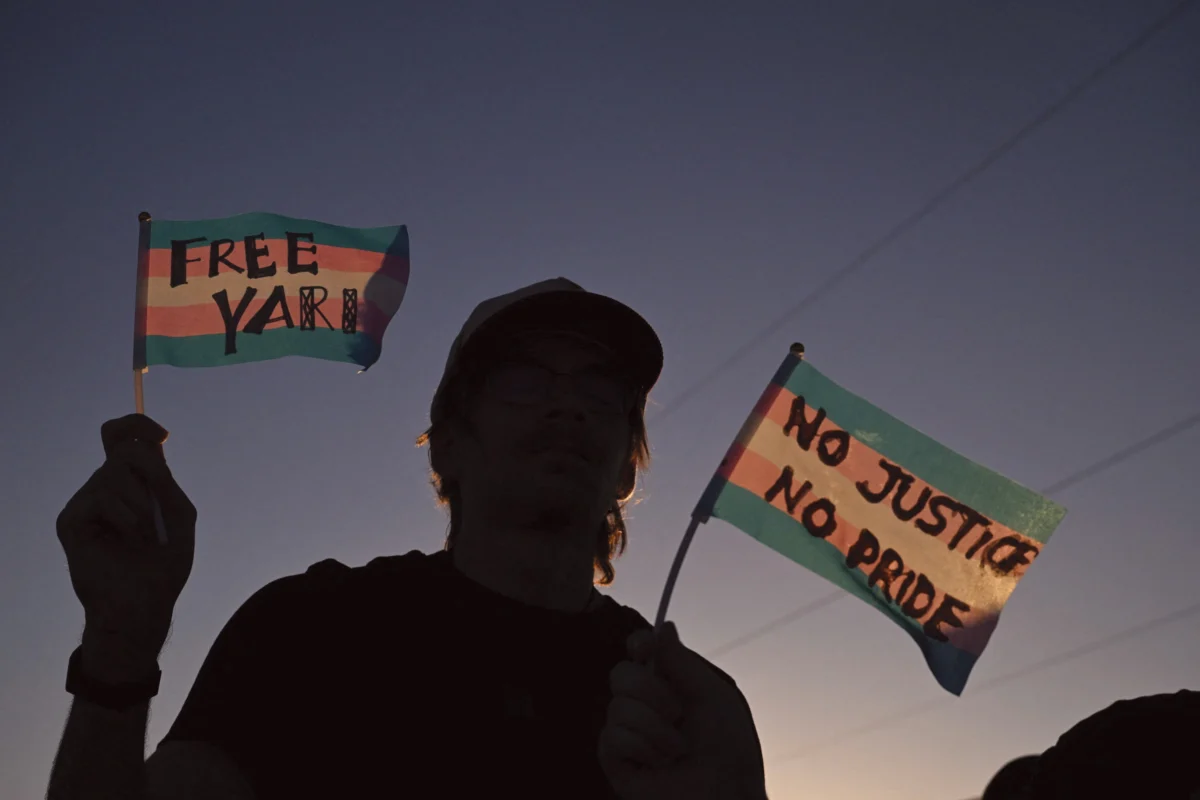
Karla Saenz, a prominent transgender woman and migrant rights advocate, recently emerged from detention at the Eloy, Arizona, facility, her pink tennis shoes lacking laces but her resolve unbroken. Despite palpable exhaustion and hunger, Saenz, 26, immediately shared her harrowing 44-day ordeal, underscoring a fierce determination to continue her fight against what she describes as systemic abuses within the U.S. immigration detention system, particularly for LGBTQ+ individuals. Her account offers a stark glimpse into the realities faced by vulnerable migrants and casts a critical light on the operations of private detention centers.

Before her own unexpected detention, Saenz had dedicated a year to campaigning for Arbella "Yari" Marquez, a lesbian Phoenix resident suffering from critical health complications, including leukemia, and significant weight loss while held in the same notorious Eloy camp. For Saenz, a trans woman herself, Marquez’s struggle was deeply personal, igniting a tireless advocacy effort. She organized public awareness campaigns, facilitated visits, and served as a vital contact for politicians and media, all aimed at exposing the dire conditions faced by LGBTQ+ migrants within these facilities. Her relentless efforts, alongside the Phoenix-based racial and gender justice organization Trans Queer Pueblo, successfully elevated Marquez’s plight onto the national stage, garnering significant attention from members of Congress and diverse community faith leaders who united in demanding humanitarian release for Marquez.
Saenz’s own journey to the U.S. border to seek asylum was itself marked by profound trauma and a desperate flight from persecution. In her native Venezuela, she endured intense violence and discrimination for her trans identity, including repeated rape, two kidnappings, and forced labor, as meticulously detailed in a habeas petition filed by her lawyers. This history of profound vulnerability underscores the inherent risks she carried into the U.S. immigration system. In a startling and controversial turn of events, Saenz was herself detained this past March during what she believed was a routine immigration check-in. Without clear explanation or due process, she was abruptly shackled and taken into custody, an experience she recounted as leaving her "crying and shaking with nerves." A week into her detention, after multiple transfers and what she described as deliberate deprivation, Saenz tested positive for COVID-19, leading to isolation within the very Eloy detention center where Marquez was held. This cruel irony placed her mere hundreds of yards from the woman she had fought so hard to free, yet rendered her utterly unable to communicate directly.

Following her initial period of isolation, Saenz spent the next six weeks housed in the men’s unit, a placement that she and other human rights advocates argue is inherently dangerous and discriminatory for transgender women, exposing them to heightened risks of harassment and assault. During this period, Marquez managed to send Saenz a letter, a powerful message of solidarity urging strength and shared hope for their eventual freedom. While her confinement prevented her from directly assisting Marquez, Saenz quickly identified other trans women within her unit who were also facing severe challenges. She instinctively took on a protective and supportive role, shielding them from the pervasive transphobia and harassment she observed from both staff and other detainees.
The Eloy Detention Center, a sprawling facility operated by the private corrections company CoreCivic since 1994, has a long and grim history, frequently cited as one of the deadliest immigration detention centers in the United States. Located amidst vast farmlands near Eloy, Arizona, the complex, identifiable by its concertina-wire double-fencing and stark gray facade, has long been a focal point for human rights concerns and sustained allegations of abuse. Accounts from detainees consistently describe chronic systemic issues including woefully inadequate medical care, unsanitary living conditions, instances of physical and psychological abuse, and frequent, prolonged lockdowns. Saenz’s personal narrative aligns disturbingly with these broader patterns; she reported being denied her essential hormone treatment and crucial medication for a chronic illness for weeks after her initial five-day isolation. Furthermore, she faced pervasive transphobia from guards, who allegedly ignored her complaints and consistently misgendered her, refusing to acknowledge her identity.

In response to Saenz’s serious allegations, an ICE spokesperson categorically denied claims of mistreatment and denied medical care, asserting that facility staff treat "all detainees equally, with respect and dignity." The agency’s statement, however, notably referred to Saenz by her deadname and used male pronouns, actions that activists highlight as perpetuating the very transphobia Saenz endured within detention. Citing patient privacy, ICE declined to comment on her COVID-19 diagnosis but maintained that Saenz had filed no official grievances while inside and that her arrest was due to missed scheduled check-ins, a claim Saenz vehemently refutes, insisting she was current on all appointments. The spokesperson also provocatively stated that "being in detention is a choice," suggesting unauthorized migrants should simply leave the country voluntarily – a perspective that critics argue disregards the complex legal and humanitarian realities faced by asylum seekers, whose lives may be at risk in their home countries.
Saenz’s detention unfolds against a backdrop of dramatically expanding U.S. immigration enforcement. In recent years, detention book-ins have surged, running over 60% higher in early 2026 compared to the same period the prior year, indicating a significant increase in the number of individuals subjected to civil immigration detention. This escalating trend has profound and often devastating implications, particularly for vulnerable populations like transgender detainees. The situation for trans individuals in custody remains alarmingly opaque; ICE controversially ceased publishing data on transgender people in detention in February 2025, making it exceedingly difficult for advocates, legal teams, and the public to monitor their welfare, track their numbers, or intervene effectively on their behalf. This critical lack of transparency exacerbates existing risks of abuse, neglect, misplacement in inappropriate facilities, and denial of gender-affirming care, undermining efforts to ensure their safety and human rights.

The extensive public campaign for Saenz, spearheaded by Trans Queer Pueblo and amplified by diligent media coverage, ultimately led to crucial legal intervention. After more than six weeks of confinement, a judge ordered her release on April 21. The very next day, Saenz tasted freedom, her first moments of liberty spent recounting her ordeal to journalists at a truck-stop Wendy’s outside Eloy, a stark and poignant contrast to the dehumanizing environment she had just left. Her testimony, gathered across phone calls while detained and subsequent interviews, vividly illustrates the profound psychological toll of detention but also reveals an unyielding spirit.
When pressed about her initial days in solitary confinement, a claim ICE had denied, Saenz asserted, "It’s not in their interest for people on the outside to know what’s happening inside. There are no human rights. There’s no respect for anybody. They do whatever they want with us. A lot of people are isolated, a lot of people are medicated [against their will], a lot of people are dying inside, and they don’t care." She recounted persistent attempts by staff to coerce her into signing voluntary departure forms, which she repeatedly refused, tearing up the papers and fighting back. "More than 10 times," she stated, "And I always refused. I would rip up the paper, fight, scream." Her struggle was further compounded by the systemic misgendering; despite her fervent pleas to be recognized as a woman, staff repeatedly referred to her as "Mr. Carlos Saenz." "I’ve been struggling with this for years, trying to escape it, and all I ask is, please, respect my identity as a woman," she implored, her voice still resonating with the pain of those interactions.

Saenz’s compassion and leadership extended to the three other trans women she encountered in the men’s unit. Though separated by facility rules from prolonged interaction, they found solace and strength in shared moments in the yard, crying and laughing together, a testament to solidarity in adversity. Saenz became their fierce defender against harassment and dehumanization, recognizing them as "my sisters." "It’s so hard to fight against a system and against the rooted machismo," she reflected. Her internal resolve, significantly bolstered by the unwavering support from Trans Queer Pueblo, prevented her from ever losing hope or compromising her identity. She viewed her detention not just as an ordeal but as an opportunity to educate both fellow detainees and even guards, explaining, "I taught them how to live with a trans woman." Her steadfast refusal to "take a break, hide who you are" demonstrates an indomitable spirit. "Never," she affirmed, "I always stood firm: that I am a trans woman, that I’m Karla Saenz, and that I won’t let anything or anyone rob me of my identity."
Since her release, Saenz admits to grappling with the profound psychological scars of her experience. "When I got out, I was scared to be out again, to return to daily life, and it felt really odd. I couldn’t sleep. I would wake up crying," she confessed, openly acknowledging the severe impact detention had on her mental and emotional well-being. "I can tell that detention really affected me. Though I always present myself as strong, and I know I have the tools to defend myself, I really believe that nobody deserves to live that life inside. It’s hell." Yet, this personal struggle has only deepened her commitment to advocacy. "I’m going to keep fighting," she declared with unwavering conviction. "Because I was able to get free, but my sisters are still inside. They’re still living that discrimination, the transphobia." Her advocacy extends not only to those still detained but also to challenging the broader system that allows such inhumane conditions to persist. The powerful drawings sent by Arbella "Yari" Marquez from inside Eloy, depicting her cell with coffins on bunk beds, serve as a stark and chilling reminder of the despair and harsh realities faced by those still confined. These poignant images, created during 17 months of limited external contact and minimal sunlight, underscore the urgent, ongoing need for continued vigilance, transparency, and fundamental reform in U.S. immigration detention practices.