Rocky Gerung
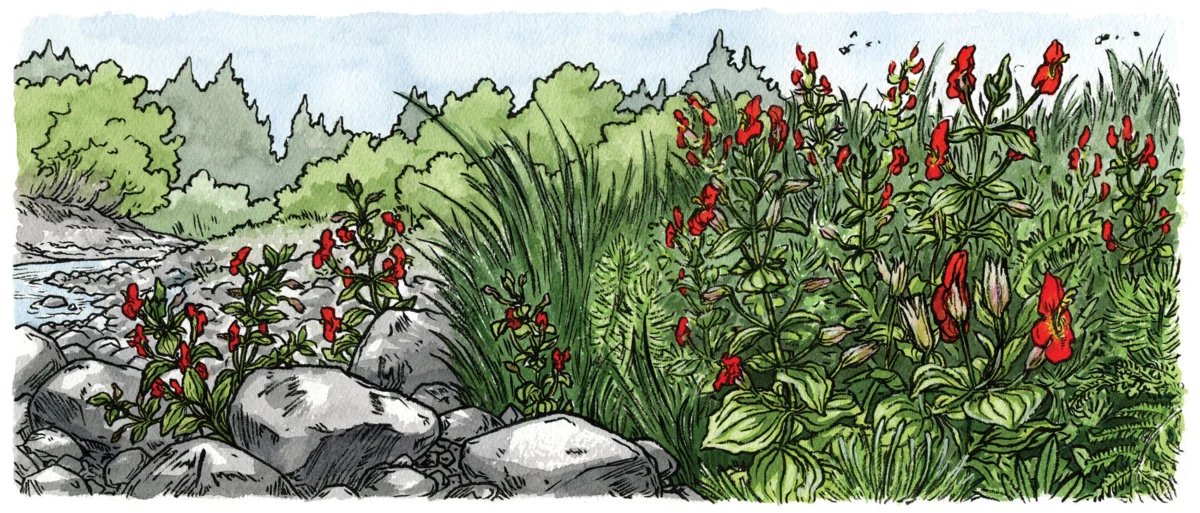
Throughout the summer months, along the streambanks that vein landscapes from Washington state down to Northern Mexico, hummingbirds are a blur of motion, drawn to the vibrant red, face-shaped blossoms of the scarlet monkeyflower, Mimulus cardinalis. These striking flowers have, over eons, developed a remarkable co-evolutionary relationship with these tiny pollinators, their intricate structures perfectly adapted to the hummingbirds’ feeding habits. As autumn arrives, these once-vivid blooms transform into elongated brown capsules, each holding thousands of minuscule, dust-like seeds, a testament to the plant’s reproductive cycle. It is these seeds, however, and the genetic material they contain, that have become a crucial resource for scientists. Though not intended for human study, this genetic legacy is proving instrumental in understanding evolutionary biology and the profound ways in which climate change is poised to reshape entire ecosystems across the Western United States and beyond.

In a significant development earlier this year, a team of researchers, spearheaded by Amy Angert, an ecologist at the University of British Columbia, published a landmark study. Their work, centered on the scarlet monkeyflower, provided the first definitive evidence that some plant species can indeed evolve rapidly enough in natural environments to effectively counter the detrimental impacts of a changing climate. This finding is the latest in a series of revelations derived from this small, trumpet-shaped flower. Previous research has illuminated how pollinators actively drive the process of speciation, demonstrated that a plant’s capacity for evolution can fluctuate significantly across its geographic distribution, and revealed that floral lineages can exhibit a form of intergenerational resilience, enabling adaptation to climatic shifts even without the introduction of new genetic mutations.
It is highly probable that this species will continue to yield groundbreaking discoveries, and Angert’s laboratory is at the forefront of this exploration. They are currently developing sophisticated models, utilizing the scarlet monkeyflower as a biological template, which hold the potential to predict the adaptive capabilities of other species. These models aim to forecast how various organisms might cope with escalating challenges such as drought, extreme heat, wildfires, and other climate-related stressors, offering a vital tool for conservation efforts. Angert expresses a strong desire to equip conservationists with the insights needed to prioritize their interventions, identifying which species or populations require immediate attention and which, like many of her diligently studied monkeyflowers, possess the inherent capacity for self-correction and adaptation – a concept she aptly describes as being able to "hold themselves up by their own bootstraps."

From Streambank to Laboratory: A Decade of Dedicated Research
Since 2010, Angert’s research team has embarked on annual expeditions, visiting dozens, and sometimes hundreds, of scarlet monkeyflower habitats. During these excursions, they meticulously record ecological observations and collect seeds to transport back to their controlled laboratory environments. Through a series of carefully designed studies, her team has employed a technique they refer to as "resurrection ecology." This involves germinating multiple generations of seeds collected from the same lineages under identical greenhouse conditions. Their findings have consistently shown that over successive generations, those lineages that experienced simulated drought conditions evolved demonstrable drought-tolerant traits, including alterations in leaf thickness and adjustments in their blooming schedules, indicating a clear adaptive response.
The scarlet monkeyflower is characterized by its fuzzy leaves, which secrete a sticky resin possessing a distinct aroma. Angert describes this scent with a touch of poetic flair: "It’s a little sweet, a little pungent. I’ve never been able to hit on the right word, but I smell that scent and I’m immediately transported." This sensory connection underscores the deep familiarity and affection researchers develop for their study subjects. These perennial plants typically establish themselves in the precarious niches found between rocks along streambanks and creeks. Their preferred locations offer a delicate balance: the water flow is neither so rapid that it dislodges them, nor so sluggish that it allows more competitive meadow grasses to encroach upon their territory. The scarlet monkeyflower typically blooms in graceful sprays atop stems that can range in height from a modest six inches in arid, challenging environments to a robust three feet in areas with greater moisture availability.

A Supermodel for Scientific Advancement
The scarlet monkeyflower has ascended to the status of a "model species" within the field of evolutionary biology, its characteristics offering profound insights that extend far beyond its own botanical realm and can be applied to a vast array of other organisms. Several factors contribute to its utility in scientific research. Notably, these plants have been the subject of scientific inquiry for an extended period, with studies dating back to the early 19th century. Furthermore, they possess a relatively short life cycle and thrive under laboratory conditions, facilitating controlled experiments. The sheer abundance of seeds produced – often exceeding 2,000 per capsule – makes the collection process highly efficient for researchers. Historically, monkeyflowers also boasted a small genome, which simplified early genetic analyses, although this advantage is diminishing in significance as the cost of gene sequencing continues to decline and computational tools for genomic analysis become increasingly sophisticated.
A Climate Toolkit for Conservation
Research originating from Angert’s laboratory has revealed a fascinating geographical disparity: southern populations of the scarlet monkeyflower exhibit a greater degree of adaptive genetic variation compared to their northern counterparts. This suggests that southern populations possess a more potent capacity to evolve more rapidly in response to identical environmental stressors. This finding carries critical implications for conservation strategies, highlighting that broad, species-wide generalizations drawn from studies of a limited number of populations may be insufficient or even misleading. The adaptive potential can vary significantly, underscoring the need for geographically nuanced approaches to conservation planning.

Many plant species possess a remarkable phenomenon known as "stress memory." This is not a genetic mutation in the traditional sense, but rather the transmission of compounds or molecular markers that influence gene expression from one generation to the next, passing from grandparents to parents to offspring. This inherited epigenetic information can equip plants with a degree of preparedness for challenging environmental conditions. Similar to direct evolutionary capacity, the effectiveness and prevalence of this "stress memory" can also differ considerably across a species’ geographic range. Angert’s team is actively investigating the hypothesis that even those populations lacking the genetic wherewithal to evolve at a pace commensurate with climate change may still be able to leverage this inherited "memory" to adapt to a rapidly altering environment.
The House Special: A Tale of Pollinator Specialization
The scarlet monkeyflower’s striking red coloration, tube-like shape, abundant nectar, and precisely positioned long stamen are all evolutionary adaptations designed to attract and efficiently pollinate hummingbirds. The stamen is perfectly situated to deposit two distinct stripes of pollen onto the forehead of each visiting hummingbird. A closely related species, the Lewis’s monkeyflower (Mimulus lewisii), has evolved a different specialization, catering to bumblebees. Its pink blossoms produce a less copious amount of nectar, and its broader petals provide a convenient landing platform for bumblebees, aiding them in their pollen collection efforts.

These two species, the scarlet and Lewis’s monkeyflowers, share overlapping geographic ranges and possess the ability to hybridize. However, they rarely do so in nature, a testament to the strong preference their respective pollinators exhibit. Evolutionary biologists have demonstrated that the divergence in floral morphology between these two species is attributable to changes in just a few key regions of their genomes. This suggests that the evolutionary process of adapting to a new pollinator can occur relatively rapidly, on the timescale of millennia, offering further evidence of the dynamic nature of plant evolution.