Johny Prima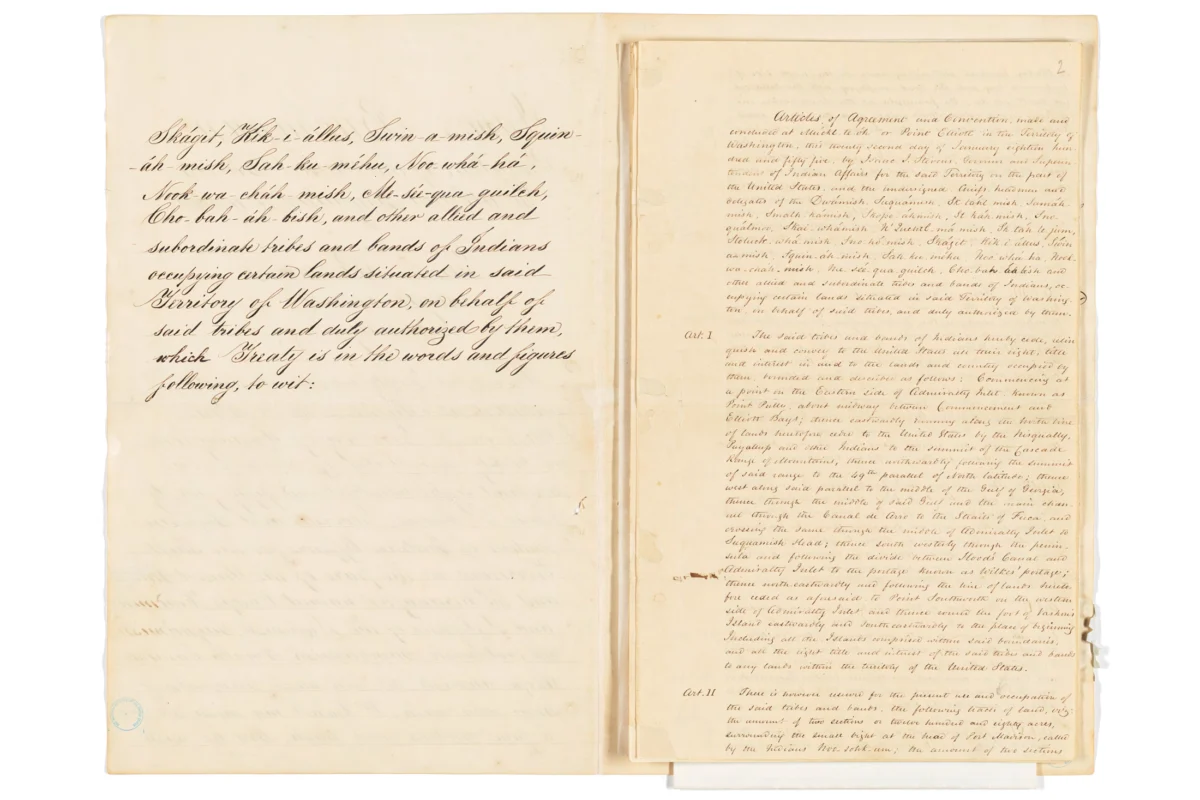
The foundational 1855 Treaty of Point Elliott, which continues to define political relationships between the modern-day United States and more than 20 Pacific Northwest tribal nations, finds its poignant genesis in a harrowing historical moment in 1792. It was then that si’aɫ, a young Duwamish and Suquamish boy of approximately six years, witnessed a foreign vessel, laden with diseases, anchor in what is now known as Miller Bay, Washington. The arrival of Captain George Vancouver’s expedition, though ostensibly for exploration, heralded an era of profound devastation for Indigenous communities. Si’aɫ, observing with his village — a vibrant population numbering in the thousands, perhaps even tens of thousands, according to contemporary Suquamish tribal accounts — bore witness to the initial encroaching shadows of colonialism. The English captain, unable to communicate in any of the region’s diverse Indigenous languages, represented a looming threat that would soon manifest in unimaginable demographic collapse. Sixty-three years later, the boy si’aɫ had matured into the revered leader Chief Seattle, presiding over a drastically diminished people, with only 272 Suquamish individuals having survived the relentless waves of foreign-borne epidemics like smallpox, influenza, and measles. By then, colonizers had firmly established their own territorial government, fundamentally altering the power dynamics of the region. For Chief Seattle, navigating this transformed landscape, a treaty emerged as perhaps the sole viable path to negotiate lasting protections and secure a future for his descendants amidst an overwhelming colonial tide.
“Chief Seattle signed that treaty with the government after witnessing so many deaths that he had to be looking out for survival for future generations,” explained Rob Purser, a Suquamish tribal member and director of treaty rights for the Suquamish Tribe. “There wasn’t no way of fighting your way out of that problem.” Faced with catastrophic population loss and the undeniable military superiority of the encroaching settlers, Indigenous leaders recognized the imperative to engage with the colonial government, making difficult concessions of land in exchange for solemn promises. However, as Purser notes, the very essence of these agreements has been routinely challenged: non-Native governments, both then and now, frequently ignore or reinterpret treaty provisions, leading to dynamic, ongoing legal and political conversations that involve the wisdom of Native ancestors, the U.S. courts, and the unwavering resolve of contemporary tribal nations. This struggle for recognition and enforcement is not unique to the Pacific Northwest but mirrors broader patterns of Indigenous rights movements across Canada, Australia, and New Zealand, where similar historical treaties are constantly being re-evaluated and defended in modern legal frameworks.
The intricate process of treaty negotiation itself was fraught with profound challenges, particularly in communication. It necessitated multiple layers of interpretation: one intermediary translating from English into Chinook Jargon, a pidgin trade language with a relatively limited vocabulary, and subsequent interpreters translating from Chinook Jargon into specific local languages such as Muckleshoot and Lushootseed. This convoluted translation chain inevitably led to significant semantic gaps and potentially distorted final interpretations, creating fertile ground for future misunderstandings and disputes. Despite these linguistic hurdles, over 80 Indigenous leaders ultimately affixed their marks to the document, which today underpins a vast array of critical issues, from fundamental fishing rights and environmental co-management to vital access to education and medical care. The Suquamish Tribe, emblematic of many tribal nations, has been compelled to defend the treaty’s provisions in the U.S. Supreme Court an astonishing nine times, consistently emerging victorious. “It was Chief Seattle’s wisdom, looking at the situation his people were under, to try to protect future generations,” Purser affirmed, underscoring the foresight embedded in the original agreement.
From a Coast Salish perspective, the very concepts of property and ownership differed fundamentally from those held by the encroaching American settlers. Joshua L. Reid (Snohomish), a professor of history and American Indian studies at the University of Washington, elucidates this crucial distinction: “Coast Salish peoples had, and continue to have, different ideas of what constitutes property, what constitutes ownership. Simply put, it’s more a system where people belong to places rather than people own places in that fee simple property way that United States property concepts observe.” This deep connection to the land, where identity and stewardship are paramount, stood in stark contrast to the Western notion of land as a commodity to be bought, sold, and exclusively controlled. Yet, Indigenous peoples were not unfamiliar with the concept of treaties and negotiations. Communities in the Puget Sound region had prior knowledge of the Douglas Treaties, which the British colonial governor had negotiated with various First Nations around Vancouver Island. This historical precedent meant they understood the framework: “We reserve certain things for us, we extend certain rights to non-Natives, and there are land cessions.”
Andrew Gobin (Tulalip), director of treaty rights for the Tulalip Tribes, powerfully articulates the profound cultural significance encapsulated within these agreements. “Our people saw what was coming, and they had the wisdom and the foresight to protect the things that are important to our people in our way of life, because truly, our entire culture is protected in the treaty,” Gobin states. He emphasizes that the rights to hunt, fish, and gather are not merely economic entitlements but safeguards for an entire cultural fabric. “Your usual and accustomed place are your family village sites, so you’re protecting your bloodline, your heritage, you’re preserving family connections, that oral tradition of handing teachings down from one generation to the next through practice, through going and doing these things. When you look out at the land and water, you see every aspect of our culture.” These "reserved rights" are paramount, signifying what tribes retained for themselves, rather than what the federal government benevolently granted.
Despite the clear constitutional mandate that treaties are the "supreme law of the land," as explicitly stated in Article VI of the U.S. Constitution, their enforcement remains an ongoing battle. Gobin laments, “Treaty rights are knowns: We know what is obligated, we know what is protected. And yet… if the tribes weren’t there to stand up and voice the concern, then [federal agencies] just move forward like [the treaty] doesn’t exist.” This persistent challenge underscores the U.S. government’s historical and ongoing failure to uphold its federal trust responsibility to tribal nations, a legal and moral obligation to protect tribal lands, assets, resources, and treaty rights. Rob Purser further clarifies a common misconception: “The government didn’t give us nothing. No tribe got gifts from the government. We reserved those treaty rights in exchange for land. And that’s the same all across the U.S.” This distinction highlights that treaties are agreements between sovereign nations, not acts of charity from a dominant power.
At the time of the treaty signings, the demographic reality in the Pacific Northwest was still one where Indigenous peoples vastly outnumbered settlers. Professor Reid points out that there were numerous instances where Native communities successfully repelled or drove settlers from contested homesteads. This dynamic loomed large in the mind of Washington Territory Governor Isaac Stevens, the primary negotiator for the U.S. government, who recognized the potential for a unified Indigenous resistance. “He knew that if Native nations banded together, they could push the settlers out. He had real motivation to try to get these treaties negotiated and signed to prevent something like that from happening,” Reid explains. Stevens’ urgency was driven by a desire to secure vast tracts of land for American expansion, particularly for the burgeoning agricultural economy and the projected transcontinental railroad.
The negotiation process, however, was marked by significant discrepancies between promises made and promises documented. Oral histories collected in the 1920s from elders who were children or young teens present at the Mukilteo treaty signing consistently recount a promise from Stevens: a large reservation would be created in western Washington, ensuring every Coast Salish man, woman, and child would receive 80 acres. “So Native peoples were like, ‘OK, this is a clear statement of protecting our land rights,’” Reid recounts. Yet, this crucial promise of a vast reservation, so vividly remembered and passed down through generations, conspicuously fails to appear in the official negotiation notes. “That’s one of those examples of the power dynamic at play — that the United States was powerful enough to ignore some of these key promises that were made in the negotiations,” Reid observes, illustrating a pattern of selective documentation and deliberate omission that undermined the spirit of the agreements.

A pivotal phrase within the Treaty of Point Elliott, guaranteeing the "right of taking fish at all usual and accustomed grounds and stations… in common with all citizens of the Territory," became the battleground for a landmark 1974 decision. In United States v. Washington, famously known as the Boldt Decision, Judge George H. Boldt interpreted this phrase to mean that treaty tribes retained the right to harvest 50% of the fish in Washington state. Boldt’s ruling dismantled decades of state-imposed restrictions on Indigenous fishing, affirming that the tribes had reserved, not been granted, this right. He wrote, “There is no indication that the Indians intended or understood the language ‘in common with all citizens of the Territory’ to limit their right to fish in any way. For many years following the treaties the Indians continued to fish in their customary manner and places, and although non-Indians also fished, there was no need for any restrictions on fishing.” The Boldt Decision not only reshaped fisheries management but also profoundly affirmed tribal sovereignty and the concept of treaties as living documents. The boundaries of what constitutes a tribe’s “usual and accustomed” fishing grounds remain a subject of active legal contention today, as evidenced by recent cases where the Quinault Tribe sought access to additional fishing grounds in Western Washington, while the Sauk-Suiattle Tribe challenged the fishing activities of neighboring nations on the Skagit River in 2021, arguing they fell outside their established territories.
The very understanding of “fishing” itself diverged dramatically between the Coast Salish and settler perspectives. “From Stevens’ perspective, fish didn’t become property until you caught it and brought it into your boat or net, whereas from Indigenous perspectives, fish were people,” Professor Reid explains. “They were more-than-human people who were part of the larger community of the Salish Sea.” For Coast Salish peoples, fish were not mere commodities but sacred beings who "gave themselves" to people through reciprocal relations and strict protocols of respect. Failure to uphold these protocols, it was believed, would lead to the disappearance of the salmon. Therefore, “fishing isn’t just the simple act of putting a fishing pole in the water and yanking a fish out. Fishing included all those protocols, the reciprocity, the preparation that went into it and all the management structures,” Reid emphasizes. When Stevens vaguely stated that the treaty would “secure your fish,” Indigenous leaders understood this to encompass the entire complex system of management oversight, cultural protocols, and relationality, a profound disjuncture from the settler’s purely extractive view. Andrew Gobin further illustrates this holistic worldview, noting, “Our language is verb-based. The parts of our language are tied to specific actions or something that happens. The word that we use for salmon is tied to something that happens every year. The way that the word is constructed, it means something that happens on a yearly cycle, and how that translates across our culture is that the times of the year are specific to where we are in that cycle of salmon.”
The Boldt Decision, therefore, represented a monumental victory for Indigenous rights across the United States. Rob Purser describes it as “the biggest positive court decision in Indian Country, period.” It took an “old treaty” — one that opponents had argued was outdated and no longer relevant — and affirmed its status as a living document and the supreme law of the land. “What that did is that brought back to life all treaties across the U.S. that were signed. Their federal court said that those are living documents and they need to be upheld,” Purser states, solidifying the legal foundation for tribal sovereignty and self-determination nationwide.
Today, tribal nations grapple with how these historic agreements translate into current and emerging issues, particularly in the face of global challenges like climate change. Andrew Gobin highlights the pressing concerns: “We’re always looking at climate change, one example being sea-level rise. Our rights are place-based. Our rights, preserved under the treaty, exist in our usual and accustomed places. Well, with sea-level rise, we get displaced of our usual and accustomed places, or with our land-based rights, which are on open and unclaimed lands. As environments shift, our people get displaced. Or as development happens, wildlife populations are displaced, and if they move outside of areas reserved under the treaty, then they become inaccessible.” This illustrates how environmental degradation and development directly threaten the very foundation of treaty-protected cultural practices and lifeways.
Even seemingly universal concepts like “family” and “friendship” carried radically different meanings across cultures during treaty negotiations. Professor Reid explains that from an Anglo-American perspective, the “Great Father” (the U.S. President) wielded paternalistic power over his “children.” However, from an Indigenous viewpoint, such a “father” could only exercise that power if he genuinely cared for his children. “When Chief Seattle would acknowledge the Great Father, Stevens got very excited and thought, ‘This means the chiefs are submitting to the power of the United States,’” Reid recounts. In reality, Chief Seattle was strategically integrating the U.S. President and other officials into the broader political family of Coast Salish peoples, a framework that inherently entailed mutual rights and responsibilities that the United States would subsequently ignore. Similarly, “friendship” within the Coast Salish context implied a network of relationality where wealthy individuals had friends in many places, and friends supported, allied with, and fed one another. “When Chief Seattle and the other Coast Salish leaders were calling Stevens and Simmons and settlers ‘friends,’ what they were trying to do was bring them into that network of relationality where you’ve got rights and responsibilities, you feed your friends, you support your friends, you ally with your friends. You don’t take their lands, screw them over, and shoot them dead.” This stark contrast in understanding laid the groundwork for future broken promises and injustices.
The practical outcomes of these misinterpretations are stark. Promises for essential services like schools and clinics, explicitly mentioned in the treaty, largely went unfulfilled. “That’s not what happened. We had to buy our own school. We’re buying our own medical facilities. None of that was ever provided,” Purser confirms. This forced self-reliance, while demonstrating tribal resilience, does not absolve the federal government of its obligations. Anthony Hillaire (Lummi), chairman of the Lummi Nation, unequivocally states, “In our efforts to take care of ourselves, in no way do we ever or will we ever let the United States of America off the hook of their treaty and trust responsibility to us.” He highlights the frustration of constantly having to compel the government to uphold its own law, noting this pattern “in health care, we see that in education, we see that in salmon recovery and co-management of our national resources — and the list goes on.”
Professor Reid emphasizes that from a settler perspective, treaties were often viewed as “one-and-done-type documents,” their continuing relevance open to debate, a notion he firmly rejects given their constitutional status as the supreme law of the land. “Most non-Natives assume that treaties were a figment of the past and are best kept in the mid-19th century. But from Indigenous perspectives, that’s not at all what a treaty is,” he asserts. For Indigenous peoples, a treaty initiates “perpetual relations” between nations, demanding continuous action and maintenance. As Lummi Tribal Council member Lisa Wilson recently articulated, “treaties are for all of us. They aren’t just for Indian people in western Washington. The treaties bind all people, Native and non-Native, together around these ideas of relationality, of how to interact with each other.”
Defending these treaty rights remains an everyday challenge, primarily due to a pervasive lack of public knowledge and historical education. Rob Purser observes, “People moving in [to our area] know nothing about tribes.” He points to the legacy of misinformation disseminated during the era of the Boldt Decision, which continues to impact public perception. While acknowledging a growing understanding and compassion among some, Purser stresses the continuous need for education. His department, operating on a government-to-government basis, faces an endless cycle of educating new officials as they enter service. “It’s a constant education with them. Because they retire. They work 40 years, retire, and they hire new people and we start all over, educating them on treaty rights,” Purser explains. This persistent effort underscores that the treaties of the past are not relics but vibrant, legally binding agreements that shape the present and future of the Pacific Northwest and, indeed, the entire nation, demanding ongoing vigilance, understanding, and respect from all its inhabitants.